Best Air Fryer Indian Recipes: Crispy Without the Oil
Crispy Indian classics made quick and easy in your air fryer

Your favourite Indian snacks and dishes made with less oil in the air fryer
Key Takeaways
- Air fryers suit Indian snacks well. Samosas, pakoras and tikka rely on dry heat and a crisp exterior.
- Yogurt-based marinades cling best. They help spices adhere and brown at high heat.
- Timings vary by appliance. Start checking earlier than a recipe suggests and judge by colour and doneness.
- Roasted snacks are the easiest win. Makhana, chana and peanuts need no oil bath and little attention.
Why Air Fryer Works Brilliantly for Indian Food
Indian cuisine has one of the richest traditions of fried food in the world. Samosas, pakoras, vadas, mathri, puri, bhajias — deep frying is woven into the fabric of Indian cooking from street food to festive spreads. The results are undeniably delicious, but the oil consumption is significant: a single batch of pakoras absorbs 2–4 tablespoons of oil per serving when deep fried.
The air fryer works by circulating superheated air at high speed around the food, creating the Maillard reaction — the same browning and crisping that happens in a deep fryer, but with a fraction of the oil. For most Indian fried foods, you use a light brush or spray of oil on the surface rather than submerging the item in a vat of it. The result is food that is genuinely crispy, golden, and delicious — not just "healthy enough to tolerate."
Indian food particularly suits the air fryer for a few reasons: the spice-heavy coatings and batters crisp up beautifully, tandoori marinades char authentically at high temperatures, and dry snacks like makhana and chana roast evenly. Some dishes that take 20–30 minutes of careful watching over a hot kadhai are done in 10–12 minutes with minimal attention in an air fryer.
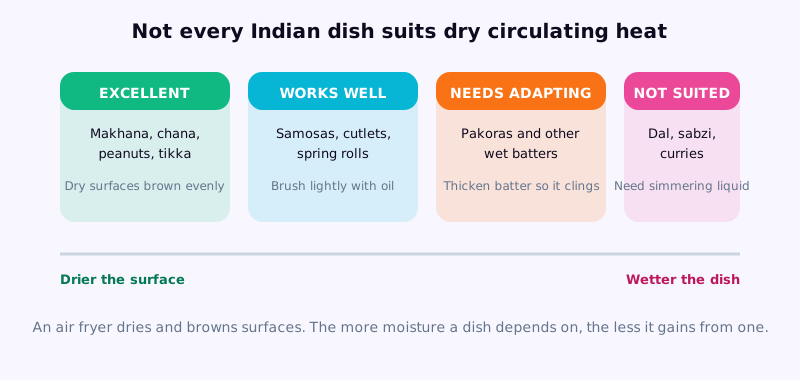
The foods that work best: samosas, pakoras, tikkas, kebabs, stuffed parathas, dry snacks, bread-based snacks, and roasted nuts and seeds. The foods that do not translate well: liquid curries, wet gravies, anything that requires submersion in water or liquid. The air fryer is a dry-heat appliance — it roasts and crisps, it does not simmer or braise.
Air Fryer Samosas (Frozen and Homemade)
Samosas are perhaps the most popular air fryer conversion among Indian home cooks, and for good reason — the results are excellent. The pastry crisps up golden and flaky without the greasiness that comes from deep frying, and you skip the careful temperature monitoring of oil.
Frozen store-bought samosas
Preheat your air fryer to 180°C if your model recommends it. Place frozen samosas in the basket without thawing, ensuring they are not touching each other. Start checking after 10 minutes and turn halfway through. For extra golden colour, brush lightly with oil before the flip. Cooking time varies with the samosa size, coating, and appliance, so use the package guidance where available.
Homemade samosas
The key difference with homemade samosas is brushing the assembled, uncooked samosas with a light coating of oil on all sides before placing them in the air fryer. This step is essential for even browning and prevents the maida pastry from going dry and floury rather than crisp. Temperature: 180°C for 15–18 minutes, turning once at the halfway point. The last 2 minutes can be bumped to 200°C for deeper colour if needed.
The most common mistake: overcrowding
Do not stack samosas or let them touch in the basket. Air fryers work by circulating air around each item — when pieces are touching, those surfaces steam rather than crisp. If you have a large batch, cook in two rounds. The second batch will cook slightly faster as the appliance is already hot.
Filling ideas that work well: classic aloo-matar, paneer and corn, chicken keema, or mixed vegetable. The filling itself does not need to change for air frying — the technique change is entirely in the cooking method.
Crispy Pakoras Without the Oil Bath
Pakoras are one of the trickier air fryer conversions — done wrong, they come out pale and doughy instead of crispy and golden. Done right, they are genuinely better than the deep-fried version for everyday eating: lighter, less greasy, and still deeply satisfying.
- The batter trick for air fryer pakoras: Make your besan batter slightly thicker than you would for deep frying. A thinner batter spreads and pools in the air fryer basket rather than coating the vegetable. The consistency should coat the back of a spoon and hold its shape when dropped — similar to a thick pancake batter.
- Onion pakoras (pyaz bhajia): Mix sliced onions with besan batter, ajwain, green chilli, and salt. Shape into rough mounds and place in a greased air fryer basket. Spray or brush lightly with oil. Cook at 200°C for 10–12 minutes, flipping gently at the halfway point. They will come out golden and crispy — genuinely so, not just lightly browned.
- Palak pakoras: Dip whole spinach leaves in batter and place flat in the basket. These are particularly successful in the air fryer because the large surface area allows the batter to crisp evenly. 200°C for 8–10 minutes.
- Paneer pakoras: Cut paneer into cubes, dip in a seasoned batter (add red chilli powder and chaat masala for flavour), and place in a single layer. 200°C for 10 minutes, turning halfway. Paneer pakoras come out with a wonderfully crisp outside and soft, warm inside — a strong result.
- Why crispier than expected: The forced hot air actually extracts moisture from the batter surface more efficiently than deep frying in many cases. Where deep-fried pakoras can sometimes be soggy if the oil temperature drops, air fryer pakoras maintain consistent heat and come out reliably crunchy.
Air Fryer Tandoori Chicken and Paneer Tikka
This is where the air fryer truly earns its place in an Indian kitchen. Tandoori dishes traditionally require a clay tandoor heated to 400°C+ — something no home kitchen has. Air fryer tandoori comes remarkably close to the real thing, with authentic charring possible at the highest temperature setting.
The marinade
Use full-fat yogurt as your base — about 3–4 tablespoons per 500g of protein is a useful starting point. Add red chilli powder, garam masala, jeera powder, coriander powder, turmeric, ginger-garlic paste, lemon juice, and salt to taste. For colour, add Kashmiri red chilli if desired. The yogurt helps the marinade cling to the protein; cooking time and browning will vary with the cut and appliance.
Tandoori chicken
Marinate bone-in chicken pieces (legs and thighs work well) for at least 2 hours in the refrigerator. Score the meat shallowly before marinating so the coating adheres. Preheat the air fryer if your model recommends it, then begin at 200°C and turn the pieces during cooking. Start checking around 18 minutes, but rely on the thickest piece reaching a safe internal temperature rather than a fixed time. Rest before serving.
Paneer tikka
Cut paneer into 3cm cubes and marinate in the same yogurt-spice mixture for at least 30 minutes (paneer absorbs marinade much faster than chicken). Thread onto soaked wooden skewers alternating with capsicum, onion, and tomato chunks. Air fry at 180°C for 10 minutes, turning once. The paneer should have golden-brown spots and the vegetables should be tender with slight char. For deeper charring, raise to 210°C for the last 2 minutes.
Roasted Snacks: Makhana, Chana, Peanuts
This is perhaps the most underrated use of an air fryer in an Indian kitchen. Dry roasted snacks that previously required constant stirring over a pan come out evenly roasted in the air fryer with minimal attention — and they stay crunchier for longer because the drying is more thorough.
Makhana (fox nuts)
Toss makhana with a very light drizzle of ghee (half a teaspoon per cup) and your choice of seasoning: salt and black pepper, chaat masala, or turmeric and cumin. Air fry at 160°C for 8 minutes, shaking the basket every 2 minutes to ensure even roasting. The makhana should come out completely crunchy and hollow-sounding when tapped. They are perfect for snacking and stay crisp in an airtight jar for up to a week.
Spiced roasted chana
Drain and dry canned chickpeas thoroughly (or use dried chickpeas soaked and boiled). Toss with a teaspoon of oil and your spice mix: cumin, coriander, chilli powder, amchur, and salt. Air fry at 180°C for 15 minutes, shaking at the halfway point. Check at 12 minutes — they should be deeply golden and crunchy throughout. These make an excellent high-protein snack and are far cheaper and healthier than packaged alternatives.
Peanuts
Raw peanuts (moongphali) need minimal preparation. Toss with a small amount of oil, salt, and optionally red chilli powder or garlic powder. Air fry at 170°C for 12 minutes, shaking at the 6-minute mark. They continue to crisp slightly as they cool — remove them when they smell toasted rather than waiting until they look fully done, to avoid over-roasting. Perfect with chai.
Air Fryer for Indian Breakfast Items
The air fryer is underutilised for Indian breakfasts, where it can dramatically speed up preparation while reducing the oil in classic morning recipes.
- Bread pakora: Dip bread slices in seasoned besan batter (the same thicker batter described in the pakora section). Place in a greased basket and spray with oil. Air fry at 190°C for 8–10 minutes, flipping halfway. Results are excellent — crispy outside, soft inside, no soggy greasiness.
- Stuffed parathas: Brush assembled, uncooked parathas generously with ghee or oil on both sides. Air fry at 180°C for 8 minutes, flip, brush again with ghee, and cook for another 4–5 minutes. The paratha comes out crispy and golden — closer to a dhaba-style paratha than a tawa one. Particularly good for aloo paratha and mooli paratha.
- Mathri: Shape your mathri dough into flat discs and poke with a fork. Brush lightly with oil. Air fry at 170°C for 12–15 minutes, flipping at the halfway point, until golden and crisp. Mathri keeps well for 2 weeks in an airtight container. A great festive batch-cooking option.
- Poha patties: Mix leftover poha with mashed potato, green chilli, coriander, and a binding of bread crumbs. Shape into patties. Brush with oil and air fry at 180°C for 12 minutes, flipping halfway, until golden on both sides. A simple way to use leftover poha in a new format.
Tips for Success With Indian Air Fryer Cooking
A few consistent habits will dramatically improve your results across all Indian air fryer cooking.
- Always preheat: Most air fryers take 3–5 minutes to reach operating temperature. Placing food in a cold air fryer extends cooking time and produces less consistent results. Preheat at the target temperature for 3 minutes before adding food.
- Never overcrowd the basket: This is the most common mistake and the one that causes the most disappointment. Food items must have space for air to circulate around them. If items are touching, they will steam rather than crisp. Cook in batches if needed — the few extra minutes are worth it.
- Oil spray vs brush: For most Indian recipes, lightly brushing with oil gives more control than a spray and ensures even coverage. An oil spray (a pump spray bottle filled with your cooking oil) works well for makhana, chana, and lighter items. For heavier items like samosas and pakoras, brushing is more effective.
- Basket liners for masala-heavy dishes: Tandoori chicken and spiced dishes leave significant residue in the basket. Perforated parchment paper liners (available on Amazon for ₹200–300 for 50 sheets) make cleanup dramatically easier while still allowing air circulation. Do not use solid foil as it blocks airflow.
- Cleaning after masala dishes: Soak the basket in warm soapy water immediately after cooking rather than letting masala residue dry and harden. Most air fryer baskets are non-stick but abrasive scrubbing damages the coating — use a soft sponge only. The heating element above the basket can be wiped gently with a damp cloth once fully cooled.
- Shake or flip at the halfway point: For most items, opening the basket and shaking (for loose items like makhana and chana) or flipping (for samosas, pakoras, tikkas) at the halfway point ensures even cooking. Most air fryers allow you to do this without interrupting the cook cycle — just pull the basket out, shake or flip, and slide it back in.
Frequently Asked Questions
Which air fryer is best for Indian cooking in India?
For Indian cooking, a larger basket capacity can be useful because many recipes involve batch cooking. Compare basket dimensions, temperature control, warranty support, and independent recent reviews rather than relying on a particular brand or model. Whichever appliance you choose, leave space around the food and expect to adjust timings as you learn how it heats.
Can you make dal or sabzi in an air fryer?
Not in a conventional basket air fryer — it is a dry-heat appliance and cannot cook liquids or wet gravies. Some air fryer oven models with accessories can bake dishes in a pan, which allows for dishes like baked dal or potato sabzi, but this is not the primary use case. For curries and dals, your pressure cooker and stovetop remain the right tools. Stick to the air fryer for what it excels at: crispy, dry-roasted, and baked items.
Why does my air fryer food come out dry?
Dryness is almost always caused by one of three things: cooking at too high a temperature for too long, not using enough oil on the surface of the food, or the item itself having very low fat content. For Indian food, ensure you always brush or spray the exterior with a small amount of oil before cooking. Do not skip this step even when using the air fryer specifically to reduce oil — a light coating is essential for the crisping reaction and prevents the food from drying out rather than crisping.
How much oil does an air fryer actually use vs deep frying?
Deep frying and air frying use oil differently. A deep fryer needs enough oil to surround the food, while an air fryer usually needs only a light coating for browning. The amount used depends on the recipe, batch size, and technique, so measure your own ingredients rather than relying on a fixed saving. Using less oil does not automatically make every recipe nutritionally better.
Can you use Indian steel plates and bowls in an air fryer?
Stainless steel is generally suitable in an air fryer when the container is heat-safe, fits without touching the heating element, and does not block necessary airflow. Check your appliance manual before using steel plates, bowls, or tiffin boxes. Avoid plastic, melamine, and materials not rated for the cooking temperature, and use heat protection when removing hot cookware.
The air fryer does not replace the joy of a freshly fried pakora on a rainy monsoon evening — but it gives you a genuinely good alternative for everyday cooking that your body will appreciate over time. Start with makhana roasting or samosas if you are new to it: those two are almost foolproof and will immediately show you what the appliance can do. From there, the rest of Indian cuisine opens up in a new, lighter, and equally delicious form.