How to Travel India on a Budget
How to explore India's most beautiful destinations on a tight budget

India is one of the most extraordinary and budget-friendly travel destinations in the world — if you know how to navigate it. A comfortable, experience-rich day in most Indian cities costs well under ₹1,000 if you eat where locals eat, travel by train, and stay in decent hostels or budget hotels. This guide covers every layer of budget Indian travel, from getting around to eating well without spending much, so you can stretch your money and see more of this vast, endlessly varied country.
Key Takeaways
- India rewards slower travel. Longer stays lower daily cost and reduce transport spending.
- Trains remain the value option. Booking classes and timing affect comfort and price considerably.
- Local eating is cheaper and often better. Busy local establishments indicate turnover and freshness.
- Many highlights are free. Markets, temples and public spaces cost little to visit.
Why India Is a Budget Traveler's Dream
Few countries offer the density of experiences per rupee that India does. Ancient temples, Himalayan landscapes, tropical coastlines, desert palaces, and some of the world's most vibrant cities are all accessible at minimal cost when you approach travel the Indian way rather than the tourist way.
- Accommodation is genuinely cheap: Clean, safe hostels exist in every major tourist town for ₹300–₹600 per night. Budget private rooms with AC start at ₹800–₹1,500 in most places outside Mumbai and Goa.
- Food costs almost nothing: A full thali meal at a local dhaba costs ₹80–₹150. Temple langar (free communal meals at Sikh gurudwaras) is available daily in many cities. Street food snacks are ₹10–₹40 per item.
- Transport is affordable: Sleeper class train travel between cities costs ₹200–₹600 for journeys of 10–20 hours. State buses are even cheaper for shorter distances.
- ₹500–₹1,000 per day is very comfortable: In most Indian cities outside Mumbai, Goa, and major hill stations in peak season, ₹500–₹1,000 covers accommodation, three meals, local transport, and entry to sights — with money to spare.
- The variety is unmatched: A single two-week trip can take you from the Rajasthani desert to Kerala backwaters to a Himalayan town — each with a completely different culture, cuisine, climate, and landscape.
Budget Accommodation Options in India
India has a wide range of budget accommodation, but prices, availability, quality, and safety vary by city, season, and property. Check recent reviews, current listings, location, and official travel guidance before booking rather than relying on a general price or safety promise.
- Hostels (₹300–₹600 per bed): Zostel is India's most well-known hostel chain with properties in 60+ destinations — clean, social, and reliable. Other quality hostel brands include Moustache and Zostel Plus. Book in advance for popular destinations during peak season.
- Dharamshalas near temples (nearly free to ₹200): Many major pilgrimage sites and temple towns (Varanasi, Rishikesh, Tirupati, Amritsar) have dharamshalas run by trusts — basic rooms at near-zero cost for pilgrims and travelers. Quality varies significantly.
- OYO Rooms (₹600–₹1,200): India's largest budget hotel aggregator. Quality is inconsistent — always read recent reviews on MakeMyTrip or Booking.com before booking. Look for properties with 4+ stars and 50+ reviews.
- Paying guest (PG) stays: For extended stays in one city, PG arrangements provide a room, sometimes meals, and a local community at ₹5,000–₹12,000 per month — far cheaper than hotels for stays of a week or more.
- Couchsurfing in India: The Indian Couchsurfing community is active in major cities — Bengaluru, Mumbai, Delhi, Hyderabad, and Pune have particularly engaged communities. It is free and often leads to genuine local connections and insider knowledge.
- Best apps for booking: MakeMyTrip and GoIbibo for domestic bookings. Booking.com for hostels and international-style hotels. Use the price filter and "guest rating" sort to find the best value quickly.
Cheap Transport Within India
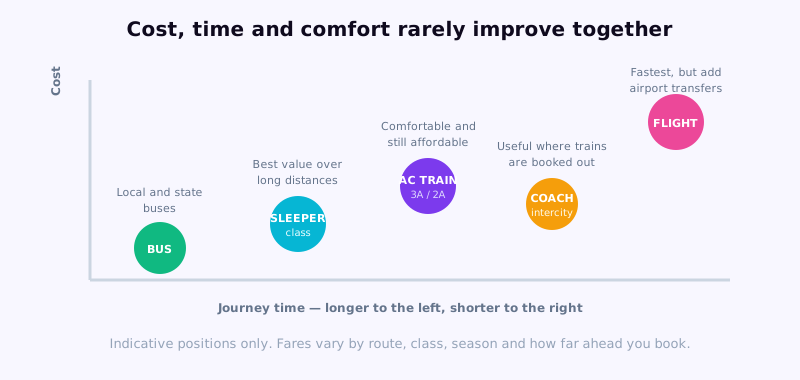
Transport is where many budget travelers overspend by taking tourist taxis when train or bus travel would cost a fraction of the price and often provide a richer experience.
- Sleeper class train travel: The backbone of budget Indian travel. A sleeper-class berth between major cities (Delhi–Varanasi, Mumbai–Goa, Chennai–Bengaluru) costs ₹200–₹500 and includes a reserved seat or berth for overnight journeys. Book on IRCTC.co.in or the IRCTC Rail Connect app — create an account in advance as registration takes 1–2 days to verify.
- Tatkal booking for last-minute travel: If trains are fully booked, tatkal quota opens 1 day before departure with a ₹100–₹400 surcharge. AC 3-tier tatkal is often the best balance of comfort and cost for long overnight journeys.
- State buses for short distances: KSRTC, MSRTC, RSRTC, and other state bus services cover routes that trains don't reach. They are slower but often cheaper and run to smaller towns. Buy tickets at the bus station on the day of travel.
- Shared autos and city buses: In smaller cities and towns, shared auto-rickshaws run fixed routes for ₹10–₹20 per person — much cheaper than app cabs. Local city buses are ₹5–₹20 for most journeys.
- Avoid tourist taxis from railway stations: Pre-paid taxi queues at major stations are overpriced for tourists. Walk 200 metres from the station and book an Ola or Uber — typically 40–60% cheaper than the tourist taxi stand quotes.
- Overnight trains save on accommodation: A sleeper-class berth for an overnight journey costs ₹300–₹500 and replaces a night's accommodation — effectively free transport if you factor in the saved hotel cost.
Eating Cheaply Without Eating Badly
Indian street food and dhaba cooking is genuinely some of the most flavourful food in the world — and the cheapest places to eat are usually the best. The tourist restaurant near the fort with English menus and inflated prices serves worse food for five times the cost of the dhaba 200 metres away.
- Thali meals at local dhabas (₹80–₹150): A thali typically includes rice or roti, dal, two vegetable dishes, raita, and pickle. It is filling, nutritious, and almost universally excellent at good dhabas. Look for places where truck drivers and office workers eat — a busy dhaba at lunchtime is a reliable indicator of quality.
- Langar at Sikh gurudwaras (free): Every Sikh gurudwara provides free meals — langar — to all visitors regardless of faith. The Golden Temple in Amritsar feeds 100,000 people per day. This is not charity; it is a spiritual practice of seva (service). Accept it graciously and consider volunteering in the langar kitchen if you have time.
- Chai and snacks: Prices vary by city and date. Busy stalls with high turnover may reduce the time food spends sitting out, but they are not automatically safe. Choose vendors with clean preparation areas, food that is cooked thoroughly and served hot, and ingredients that appear properly stored.
- Avoid tourist zone restaurants: The restaurant directly opposite the Taj Mahal, Gateway of India, or any major monument charges 3–5x more than equivalent food 500 metres away. Walk away from the monument area before sitting down to eat.
- Eat where locals eat: The simplest indicator of a good, cheap restaurant: are local families and office workers eating there? If yes, the food is good and fairly priced. If the menu has photos and English translations and the staff approach tourists on the street, move on.
Free and Low-Cost Things to Do in India
India is extraordinarily generous with free experiences — many of its most memorable sights cost nothing at all.
- Temples, ghats, and religious sites: Most Hindu temples, Sikh gurudwaras, mosques, and churches in India are free to enter. The Varanasi ghats at sunrise, the Golden Temple in Amritsar, the temples of Hampi — these are among the most powerful experiences in the country and cost nothing.
- Beaches: Goa, Kerala, Odisha, Tamil Nadu, and Andhra Pradesh all have beautiful beaches that are completely free. The cost only comes from staying nearby or renting a sunbed — both of which you can skip.
- National parks and wildlife sanctuaries: Entry fees are low — ₹50–₹200 for Indian nationals. Jeep safaris cost more (₹1,500–₹3,000 shared), but the park entry itself is accessible. State museums often charge ₹10–₹50 for entry.
- Local markets as entertainment: Wandering through a busy Indian market — Chandni Chowk in Delhi, Crawford Market in Mumbai, Russell Market in Bengaluru, or any town's weekly bazaar — costs nothing and immerses you completely in local life, colour, and energy.
- Festivals: If your travel dates align with a local festival — Holi, Diwali, Pongal, Durga Puja, Pushkar Fair — attending is often free and unforgettable. Check local festival calendars when planning dates.
- Sunrise and sunset viewpoints: Watching the sunrise over the Ganges in Varanasi, sunset at Hampi's Hemakuta Hill, or dawn at any Himalayan viewpoint costs nothing and is often the highlight of a trip.
Budget-Friendly Indian Destinations
Some Indian destinations are significantly cheaper than others — often because they are less saturated with international tourism, which keeps prices local rather than tourist-inflated.
- Hampi (Karnataka): A UNESCO World Heritage site of ruined Vijayanagara Empire temples scattered across a boulder-strewn landscape. Accommodation starts at ₹400 per night, food is very cheap, and the main cost is hiring a bicycle (₹100–₹150/day) to explore the ruins. Avoid December–January peak season.
- Rishikesh (Uttarakhand): The yoga and spiritual capital of India on the Ganges. Cheap ashrams offer accommodation and meals as part of yoga packages. White-water rafting, bungee jumping, and trekking are available at reasonable prices. Avoid July–August monsoon.
- Varanasi (Uttar Pradesh): One of the world's oldest cities and perhaps India's most spiritually intense. Guesthouse rooms overlooking the ghats start at ₹500. Most of the best experiences (morning boat ride on the Ganges, evening aarti) cost very little.
- Mcleodganj (Himachal Pradesh): Home of the Tibetan government in exile and the Dalai Lama's residence. Excellent Tibetan and Israeli food (a budget staple), cheap guesthouses, and stunning Himalayan trekking with minimal entry fees.
- Pushkar (Rajasthan): A small lake town with a relaxed atmosphere, good vegetarian food, and cheap guesthouses. Stay outside the camel fair period (October–November) to avoid inflated prices.
- Kolkata (West Bengal): India's most underrated major city — genuinely cheap, culturally rich, with outstanding food, colonial architecture, and a vibrant arts scene. Metro travel is ₹5–₹25, and excellent street food and restaurants are affordable throughout the city.
- Avoid peak season to save 30–50%: Prices for accommodation and transport in popular destinations like Goa, Manali, Darjeeling, and Jaisalmer can double or triple during peak season (December–January for beaches and desert, May–June for hill stations). Shoulder season — February–March or September–October — offers excellent weather and significantly lower prices.
How to Stretch Your Travel Budget Further
Beyond the basics of cheap accommodation, trains, and local food, a few specific habits and tools can meaningfully reduce what you spend without reducing what you experience.
- Negotiate prices — politely: Haggling is expected and normal in Indian markets, with auto-rickshaws (without meters), at tourist shops, and in smaller guesthouses. Start at 50–60% of the quoted price, be friendly, and be prepared to walk away. Never haggle over food at dhabas or chai stalls — those prices are already fair.
- Check Google Maps before asking for prices: Before negotiating an auto or cab fare, check Google Maps for the distance. A 3-kilometre journey should cost ₹40–₹60 by auto in most cities. Knowing the actual distance prevents the most common tourist overcharge.
- Use IRCTC tourist card or UPI for payments: Many tourist-facing services in India accept UPI (Google Pay, PhonePe, Paytm). Paying digitally often removes the "tourist price" dynamic and creates a receipt. For train bookings, IRCTC accepts all major debit and credit cards.
- Student discounts at monuments: Many ASI (Archaeological Survey of India) monuments offer 50% discounts for Indian students with a valid ID card. International student cards (ISIC) are accepted at some sites. Always ask before paying full price.
- Avoid airport food and airport area restaurants: The 2-kilometre radius around any major Indian airport has restaurants charging 3–5x the normal price. Eat before arriving at the airport or after reaching your destination. Similarly, avoid restaurants immediately outside major railway stations.
- Download offline maps (Google Maps or Maps.me): Navigating without mobile data saves significantly on SIM data costs and prevents getting lost in areas with poor coverage. Download the relevant Indian state maps before you travel to each region.
Frequently Asked Questions
How much money do you need for a 7-day trip in India?
A very comfortable 7-day trip — hostels or budget hotels, local food, train travel between 2–3 cities, and entry fees for sights — costs ₹7,000–₹14,000 for domestic travelers (₹1,000–₹2,000 per day). On a tight budget, ₹4,000–₹6,000 for the week is achievable with sleeper trains, cheap guesthouses, and dhaba meals. For international travelers, USD 100–150 per week (roughly ₹8,000–₹12,500) is comfortable by almost any standard.
Is India safe for solo budget travelers?
India is generally safe for solo travelers, including women, though as with any country it requires common-sense precautions. Stick to well-reviewed guesthouses, use app cabs at night rather than random autos, keep digital copies of your documents, stay aware in crowded areas, and trust your instincts if a situation feels uncomfortable. Solo female travelers should research destination-specific safety, as experiences vary significantly by region. Tier-1 cities, major tourist towns, and Sikh-pilgrimage destinations are generally considered safe.
How to book IRCTC trains as a beginner?
First, register on irctc.co.in — provide your email and phone number, verify both, and wait 24–48 hours for account activation. Then search for your train, select sleeper class (SL) for the cheapest berths or 3A/2A for AC options, choose your preferred berth type (lower berths for comfort, upper for privacy), and pay via UPI, debit card, or net banking. Download the IRCTC Rail Connect app for easier mobile booking. For popular routes and peak season, book 30–60 days in advance — tatkal quota opens 24 hours before departure for last-minute needs.
What's the cheapest month to travel in India?
The monsoon months — July and August — are the cheapest for most destinations, with accommodation prices dropping 30–50% and fewer crowds. The tradeoff is heavy rain and reduced outdoor activities in most regions. For hill stations and some parts of the northeast (Meghalaya, Coorg), monsoon is actually beautiful rather than restrictive. September and October are excellent value — the rains recede, prices stay low, and landscapes are lush and green. February–March is another good value period before the summer heat arrives.
Which Indian states are cheapest to travel in?
Uttar Pradesh (Varanasi, Agra, Lucknow), Madhya Pradesh (Khajuraho, Orchha, Mandu), West Bengal (Kolkata, Darjeeling), Odisha (Puri, Konark, Bhubaneswar), and most of the northeast states (Assam, Meghalaya, Sikkim) are generally cheapest for accommodation and food. Rajasthan is beautiful but has significant tourist pricing in peak season. Goa and Himachal Pradesh hill stations are the priciest during peak periods. Kerala, while relatively more expensive, is still very affordable by international standards.
Budget travel in India is not about going without — it is about going local. The train, the dhaba, the shared auto, the free temple, the crowded market: these are not the consolation prizes of budget travel; they are the actual experience of India. The traveler who spends ₹800 a day eating thalis, sleeping in dorms, and crossing the country by sleeper class comes home with richer stories and more genuine memories than the one who spent ten times as much in the tourist bubble. Plan smart, book early, eat local, and India will give you more than you expect at every price point.