Easy DIY Home Projects Anyone Can Do
Easy, affordable DIY projects that make your home look and feel better

DIY home projects are one of the most satisfying ways to improve your living space — you save money, learn practical skills, and end up with something that feels genuinely personal. The best projects for beginners are those that have a clear outcome, require minimal specialist tools, and have a forgiving margin for error. These projects are chosen specifically because they deliver great results without prior experience.
Key Takeaways
- Your first project should be low risk. Painting and simple storage build skill without costly mistakes.
- A small tool set covers most beginner jobs. Buy as projects require rather than all at once.
- Safety steps are not optional. Eye protection, ventilation and electrical caution prevent avoidable injury.
- Know when to hire a professional. Structural, gas and major electrical work belong with qualified trades.
Choose the Right First Project
Match the project to your tools, surface, time, and tolerance for rework. A good first project changes one visible area, can be paused safely, and does not affect plumbing, gas, structure, or mains electricity. Before buying materials, write down the finished size, surface condition, required fixings, drying time, and where you will work while the project is incomplete.
- Low-risk starting point: choose painting, patching, cable management, or removable storage before cutting or drilling into a wall.
- Make a materials list: include preparation supplies, protective equipment, fixings, cleanup, and one spare item for a mistake.
- Test the surface: check paint adhesion, wall type, and hidden pipes or cables in a small area before committing.
- Stop at the boundary: hire a qualified professional for gas, structural changes, major plumbing, and electrical work beyond your local rules and experience.
Why DIY Is Worth Learning
- Cost savings: Labour is often the most expensive part of home work — doing it yourself slashes costs
- Skill building: Each project builds confidence and capability for the next one
- Customisation: You can match exactly what you want rather than settling for what's available
- Problem solving: DIY develops practical thinking that transfers to many areas of life
- Pride of ownership: Using something you've made yourself is a genuine daily satisfaction
Best Beginner DIY Projects: Walls and Painting
- Painting a room: Cut-in the edges with a brush, fill the centre with a roller — prep is everything
- Creating a gallery wall: Lay photos on the floor to plan the arrangement, use paper templates before nailing
- Painting furniture: Sand, prime, and use furniture-specific paint for durable results
- Patching small holes: Lightweight filler, sand flat when dry, repaint — invisible in under an hour
- Adding wallpaper to one wall: Peel-and-stick wallpaper requires no paste and is fully removable
Storage and Organisation DIY Projects
- Floating shelves: Mark studs, use a level, and use appropriate wall anchors — genuinely straightforward
- Pegboard organisation wall: Cut to size and mount in a garage, office, or kitchen for flexible storage
- Ladder shelf: Two lengths of timber and some dowels make an elegant leaning shelf
- Under-sink cabinet organisation: Add a tension rod for spray bottles, stackable bins, and lazy Susans
- Cable management box: A small wooden or fabric box conceals routers, power strips, and cable clutter
Outdoor DIY Projects
- Raised garden bed: Untreated timber boards and corner posts — build in a morning, grow food for years
- Painted front door: A fresh coat in a bold colour transforms a home's kerb appeal instantly
- Patio furniture refresh: Sand and repaint metal or wood furniture to look brand new
- Gravel path: Lay landscape fabric, add edging, and fill with gravel — no cement needed
- Fence post painting or staining: A weekend project that dramatically refreshes an outdoor space
Essential Beginner DIY Tools to Own
- Power drill and bits: The single most useful tool in any home — buy a good cordless drill
- Spirit level: Ensures shelves, frames, and fixtures are actually straight
- Stud finder: Locates studs behind walls for secure, weight-bearing fixings
- Sanding block and sandpaper: Essential for paint prep on any surface
- Tape measure and pencil: Measure twice, cut once — always
- Safety glasses and dust mask: Non-negotiable for any cutting, sanding, or drilling work
DIY Safety Basics You Should Never Skip
Safety is the one area where shortcuts have real consequences. Most DIY injuries happen not to reckless people but to careful ones who skipped a precaution because a task seemed too small to warrant it. Building safe habits from your very first project means they become automatic — and you carry them into more ambitious work without having to think twice.
Good safety practice also makes you a more confident DIYer. When you know you've prepared properly, you work with less anxiety and more focus.
- Always turn off power at the breaker before any electrical work: Even replacing a light fitting carries risk if the circuit is live — never rely on a wall switch alone.
- Wear safety glasses and a dust mask for any cutting or sanding: Fine particles and flying debris cause injuries that happen too quickly to react to.
- Check for hidden pipes and cables before drilling: A pipe detector and stud finder are inexpensive tools that prevent genuinely costly mistakes.
- Keep your workspace tidy as you go: Loose offcuts, extension leads across walkways, and scattered tools are how accidents happen — a clean site is a safe site.
- Read tool manuals before first use: Modern power tools have specific safety mechanisms and proper grip positions — understanding them before switching on takes five minutes and matters.
- Never rush a cut or a drill: Most DIY injuries happen when someone pushes a tool faster than it's designed to work — let the tool do the work at its own pace.
When to DIY and When to Hire a Professional
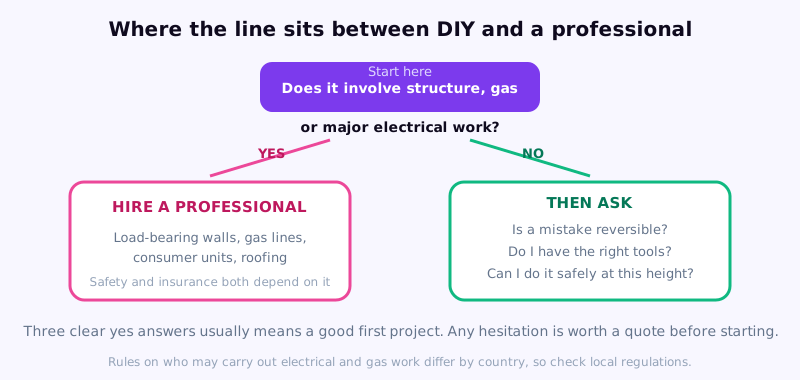
Knowing when not to DIY is a mark of a skilled, experienced home improver — not an admission of defeat. Some tasks are genuinely beyond safe DIY scope regardless of your skill level, either because they require licensed certification, carry significant safety risk if done incorrectly, or can cause hidden damage that costs far more to fix than the original job would have. Getting this judgement right saves money and protects your home and family.
A useful rule: if an error would be invisible until it causes serious harm — a slow gas leak, faulty wiring behind a wall, a load-bearing structure weakened — hire a professional.
- Always hire for gas work: Gas installations and repairs are legally required to be carried out by a certified engineer in most countries — this is a non-negotiable safety boundary.
- Hire for main electrical circuit work: Adding a new circuit, replacing a consumer unit, or rewiring a room requires certification and inspection — cosmetic electrical work (changing a socket face plate, replacing a light fitting) is generally DIY-safe.
- Hire for structural changes: Removing or altering walls, especially in older buildings, can affect structural integrity — always get a structural engineer's assessment before proceeding.
- DIY is ideal for cosmetic and decorative work: Painting, tiling, installing shelves, laying flat-pack furniture, garden landscaping, and most interior decoration projects are firmly within beginner reach.
- Get quotes before deciding: Sometimes a professional job is cheaper than you expect, especially when you factor in tool hire, material wastage, and your time — always compare the real total cost.
Frequently Asked Questions
What tools do beginners actually need for DIY projects?
A solid beginner toolkit includes: a hammer, a set of screwdrivers (flathead and Phillips), a tape measure, a cordless drill with basic bits, a level, pliers, and a utility knife. These seven items will handle the vast majority of beginner projects. Add a sander and paintbrushes if you plan to refinish furniture. Avoid buying specialty tools until you have a specific project that requires them.
How do I learn basic DIY skills with no background?
YouTube is the best free resource — search for specific tasks ("how to patch a wall hole", "how to paint a room without streaks") and watch 2-3 videos before starting. Home improvement stores like B&Q or Home Depot often offer free workshops. Start with a low-stakes project (painting an accent wall, replacing cabinet handles) where mistakes are easy to fix before tackling anything structural.
Which DIY projects add the most value to a home?
Fresh paint throughout the home consistently delivers the best return on investment — it transforms spaces dramatically for minimal cost. Updating kitchen cabinet hardware and bathroom fixtures adds perceived value at low expense. Improving curb appeal (painting the front door, tidying the garden, new house numbers) makes a strong first impression. Replacing dated light fittings is another high-impact, low-skill upgrade.
When should you hire a professional instead of doing it yourself?
Always hire professionals for electrical work beyond replacing a light fitting, gas-related work, structural changes (removing walls, altering load-bearing elements), plumbing beyond simple tap replacements, and roofing. If a mistake could be dangerous, cause serious water damage, or be extremely expensive to fix, the professional fee is money well spent. DIY is for cosmetic improvements, not anything touching safety systems.
Is DIY actually cheaper than hiring a contractor?
For cosmetic projects, yes — often significantly so. Labour is typically 50-70% of professional job costs, so doing it yourself on painting, tiling, or furniture assembly can mean substantial savings. However, factor in your time, any tools you need to buy, and the risk of mistakes that require professional fixing. For complex or structural work, botched DIY often costs more to rectify than the original professional quote would have been.
Every skilled DIYer started exactly where you are now. The first few projects will feel slow and uncertain, but each one builds capability that transfers directly to the next. Start small, watch a video tutorial for anything unfamiliar, don't rush the preparation steps, and you'll be genuinely surprised by what you can accomplish in a weekend. Your home is worth the effort.