Budget Home Decor Ideas That Look Expensive
Fresh, creative ideas to refresh your home's look without a big budget

You don't need a designer budget or a complete renovation to make your home feel fresh and beautiful. Some of the most impactful decorating changes cost very little — and many involve rearranging, swapping, or adding small elements that shift the entire mood of a room. Whether you're moving into a new space or simply tired of how your current home feels, these ideas will help you transform any room with intention and creativity.
Key Takeaways
- Plan the room before buying anything. Measurements and a palette prevent mismatched purchases.
- A few changes carry most of the impact. Lighting, textiles and arrangement shift a room more than new furniture.
- Cohesion is what reads as intentional. A limited palette ties unrelated pieces together.
- Texture adds depth without clutter. Mixing materials avoids filling a room with more objects.
Plan a Room Before Buying Decor
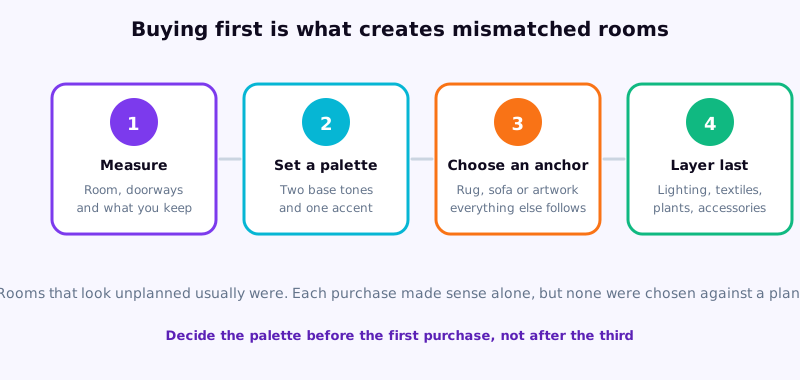
Choose one room and write down its job, the items that must stay, and the problem you want to solve. Photograph the room in daylight and at night, measure the main wall and walking routes, and collect three or four colours from an item you already like. Buy or make one anchor piece first, then test smaller items against it. This prevents a room filling with attractive pieces that do not work together or leave enough space to use it comfortably.
- Set a per-room limit: separate the budget for paint, lighting, furniture, textiles, and finishing details before shopping.
- Check scale: tape the footprint of a rug, table, or sofa on the floor before ordering it.
- Use a sample: view paint, fabric, and wood finishes in morning, afternoon, and artificial light.
- Finish one zone: complete the seating area or entryway before buying accents for the next room.
High-Impact, Low-Cost Changes
The highest-impact decorating changes are often the ones that cost nothing or very little, because they address the fundamentals of how a room feels rather than what it contains. Rearranging furniture is the most underestimated of these: changing the layout shifts traffic flow, alters the proportions, and can make a room feel entirely different without removing or adding a single item. Most furniture arrangements in most rooms are the first one someone tried and never revisited. Trying the sofa against a different wall, or floating furniture away from walls rather than pushed against them, can transform the space immediately.
Lighting is the single highest-impact change most people can make for minimal cost. Replacing harsh cool-white overhead bulbs with warm-toned ones (look for 2700K–3000K colour temperature) changes the mood of a room at every hour of the day. Adding a floor lamp or a table lamp creates layered light — a mix of ambient and task lighting that makes rooms feel more inviting and designed. Large mirrors amplify this: placed opposite a window, they double the natural light and make any room feel more spacious. New cushion covers and a throw blanket in updated tones change the entire colour story of a sofa or bed for a fraction of the cost of new furniture. Plants add life, texture, and a quality that no manufactured object can fully replicate.
Styling Principles That Make Rooms Look Intentional
There are a small number of visual principles that separate styled rooms from assembled ones. The first is the rule of odd numbers: groups of three or five objects feel more dynamic and natural than groups of two or four, which tend to look either too symmetrical or too sparse. When styling a shelf or coffee table, work in threes — tall object, medium object, small object — varying height and scale so the eye has somewhere to travel. Monotony in object size flattens any vignette, regardless of how attractive each individual piece is.
Every room should have a focal point — one element the eye is drawn to first before exploring the rest. In a living room this is often the fireplace or a piece of artwork above the sofa; in a bedroom it's the bed and what's above it. Designing deliberately around a focal point gives the room visual structure. The rule of thirds — placing objects at one-third or two-thirds of a surface rather than always centring them — creates more natural-looking arrangements. Limiting your colour palette to three choices (dominant, secondary, and accent) prevents visual noise and creates the sense of cohesion that makes a room feel considered rather than accumulated.
Room-by-Room Quick Updates
In the living room, the fastest transformation comes from new cushions, a throw blanket, and a styled coffee table tray. The tray is the key: it groups a plant, a candle, and a book into a deliberate arrangement rather than objects scattered across the surface. In the bedroom, crisp white bed linen is the closest thing to a universal improvement — it reads as clean, fresh, and restful regardless of other colour choices in the room. Two matching lamps on bedside tables create symmetry and practical light; artwork or a print above the headboard gives the bed a backdrop that grounds the room.
The kitchen benefits most from grouped organisation that is also decorative: dishware arranged visibly on open shelving, a small herb plant on the windowsill, wooden utensils in a ceramic jar by the stove. These are functional items that become visual elements when presented thoughtfully. In the bathroom, rolled towels in a woven basket replace stacked flat ones and look considerably more considered. A small plant tolerant of humidity — a pothos or ZZ plant — adds life to a room that often has none. In the hallway, a mirror, a hook rail for bags and coats, and a doormat in a consistent colour story transform the first thing visitors see into something welcoming and intentional.
Decorating on a Budget
The best decorating finds are rarely from chain stores. Thrift shops, charity shops, and second-hand markets are reliably good sources for ceramics, glass vases, vintage frames, and objects with character that new retail stock rarely has. The key is training your eye to look past surface grime or an ugly paint colour to the underlying form of an object. A well-shaped vase that needs cleaning, or a solid wooden frame that needs repainting, is worth far more than its price tag. Online second-hand platforms frequently list furniture for 20–30% of its original retail price, particularly when owners are moving and need a quick sale.
Nature is the most overlooked decorating resource available for free. Dried seed heads, branches, stones, shells, and foliage bring texture and organic form that manufactured objects rarely replicate. A tall vase of dried pampas grass or eucalyptus costs nothing to gather and lasts for months. The DIY option — painting, reupholstering, or updating hardware on inexpensive finds — extends the budget further. A can of matt white paint transforms a mismatched collection of frames into a cohesive gallery wall. New handles and knobs on a dated piece of furniture can make it look like something from a boutique.
Decorating Mistakes Worth Avoiding
Small artwork scattered across walls is one of the most common and easiest mistakes to make. Individual A4-sized prints placed at random look cluttered and timid — they don't have the presence to anchor the space. The solution is either to go larger (one print that's genuinely substantial for the wall) or to group smaller pieces tightly in a deliberate gallery arrangement with consistent spacing. The same principle applies to rugs: an undersized rug in a large room looks like an afterthought. Most design guidance is to size up — the rug should extend beyond the furniture, not sit underneath just the coffee table.
The instinct to match everything — furniture set, cushions, curtains — produces rooms that feel more like a showroom than a home. Curated mismatch, where items share a colour palette or material quality but not an identical source, reads as more authentic and personal. Decorating before editing is also a reliable way to undermine any effort: adding decorative items to a room full of accumulated clutter rarely works. The clutter dominates. Declutter first, see what the room actually looks like without the excess, and then decide what to add.
Choosing a Cohesive Colour Palette
One of the most common reasons a room fails to feel intentional is the absence of a colour story. When colours are chosen room by room or piece by piece without a unifying plan, spaces feel disjointed even when individual items are attractive. Building a simple palette before you buy or decorate saves time, money, and the frustration of things that don't quite work together.
- Start with one fixed element: A sofa, a rug, or existing flooring you can't change — build your palette from what's already there
- The 60-30-10 rule: 60% dominant colour (walls, large furniture), 30% secondary (upholstery, rugs), 10% accent (cushions, artwork, accessories)
- Limit to three colours maximum: More than three competing colours creates visual noise — neutrals count as one of your three
- Repeat each colour at least three times: If a colour appears only once, it looks like an accident — repeat it in different scales and textures to tie the room together
- Test paint on the wall: Paint always looks different in situ than on a card — apply a test patch and observe it in morning and evening light before committing
- Use tonal variation: Different shades of the same colour — light and dark — add depth without introducing a new colour to manage
Adding Texture Without Adding Clutter
Texture is what separates a room that looks flat and sterile from one that feels rich and inviting. It's also one of the most overlooked decorating tools, often confused with adding more stuff. In reality, texture is about surface, material, and depth — and it works best when layered thoughtfully rather than accumulated carelessly.
- Linen and cotton cushions: Natural fabrics introduce soft texture at low cost — a linen cushion reads differently from a smooth velvet one even in the same colour
- Woven and rattan accents: A rattan side table, wicker basket, or jute rug adds organic warmth that balances smooth, painted, or upholstered surfaces
- Chunky knit throws: A heavy knit throw draped over a sofa or chair adds tactile richness and makes seating look inviting
- Textured wall treatments: Limewash paint, exposed brick, or a feature of reclaimed wood panelling adds depth without any furniture at all
- Layered rugs: Two rugs of different textures and sizes layered together add dimension to a floor without extra furniture
- Ceramics and stoneware: Handmade pottery and stoneware have surface variation that mass-produced items lack — even a single handmade bowl changes the feel of a shelf
Great home decor is less about spending money and more about developing an eye for what works — scale, proportion, colour, and light. Start with the high-impact, low-cost changes, observe how the room feels, and build gradually. The homes that feel most beautiful and personal are usually ones that have been layered thoughtfully over time, not styled in a single weekend spending spree.
Frequently Asked Questions
How to decorate a living room on a small budget?
Start with what you have — rearrange furniture, swap cushion covers, and add a throw. Then focus on one or two high-impact additions like a large mirror or a statement plant. Shopping at thrift stores and online second-hand marketplaces gives you the most value. You rarely need to buy everything at once; the best rooms are built gradually.
What are the best affordable decor stores online?
Online marketplaces like Facebook Marketplace, eBay, and Craigslist offer pre-loved furniture at a fraction of retail prices. For new items, stores like IKEA, H&M Home, and Wayfair frequently have budget-friendly options. Searching for items by category on Etsy can also surface handmade and unique pieces at accessible prices.
Which decor changes make the most impact for the least money?
Lighting changes are the single highest-impact, lowest-cost update you can make. Swapping harsh overhead bulbs for warm ones and adding a floor or table lamp transforms the mood completely. After lighting, new textiles — cushion covers, throws, and a rug — dramatically change the colour and feel of a room without touching the walls or furniture.
How to decorate without buying anything new?
Rearrange furniture to change traffic flow and perspective. Move decor items between rooms — a vase that felt out of place in the bedroom might be perfect in the hallway. Edit ruthlessly by removing items that don't belong, and group the things you keep intentionally. Nature also offers free decoration: branches, stones, dried seed heads, and foliage cost nothing.
Where should you start when decorating a new home?
Always start with the room you spend the most time in — usually the living room or bedroom. Establish your colour palette first based on existing elements you can't change (flooring, large furniture). Then layer in textiles, lighting, and accessories. Avoid buying decor for every room at once; it's better to do one room well than all rooms poorly.