Meal Prep for Beginners: One Session, a Week of Food
One hour on Sunday sets you up for a full week of stress-free home cooking

Meal prepping — preparing food in advance for the week — is one of the most practical habits you can build in the kitchen. Even a single hour on a Sunday can mean the difference between a week of nourishing home-cooked meals and a week of expensive takeout and pantry raids. If you've been curious about meal prep but don't know where to start, this guide walks you through everything you need to set yourself up for success.
Key Takeaways
- Prepping components beats prepping full meals. Cooked grains, proteins and vegetables combine in more ways and stay appealing longer.
- Start with one meal a day. Prepping everything at once is the most common reason beginners stop.
- Storage decides whether prep succeeds. Correct containers and cooling protect texture and safety.
- Batch proteins form the weekly foundation. One cooking session supports several different meals.
What Meal Prep Actually Means
Meal prep isn't one thing — it's a spectrum of approaches, and choosing the right one for your life makes the difference between a practice that sticks and one that gets abandoned after two weeks. At one end is full meal prep: cooking complete, portioned meals for the entire week — five identical lunches in containers, dinner components assembled and ready to reheat. This is efficient but requires upfront planning and tends to work best for people with predictable schedules. At the other end is ingredient prep: washing and chopping vegetables, cooking a batch of grains, and marinating proteins in advance, so that actual cooking during the week is reduced to assembly rather than starting from scratch.
Batch cooking — making a large quantity of one dish to eat across several meals — sits in between. A pot of dal, a tray of roasted vegetables, a large chicken curry, or a batch of overnight oats all serve multiple meals without requiring a full Sunday session. Partial prep is the lowest-commitment entry point: doing just the time-consuming parts (peeling and chopping, cooking the base sauce) ahead of time so weeknight cooking is faster without feeling like a production. For most beginners, starting with batch cooking or partial prep is more sustainable than attempting a full weekly meal prep session from day one.
Why Meal Prep Is Worth the Investment
The primary benefit of meal prep is the trade — one or two focused hours once a week in exchange for fast, easy access to good food every day of that week. Cooking for 30 to 45 minutes every evening sounds manageable, but when you factor in deciding what to cook, checking what ingredients you have, and cleaning up after each meal, the actual daily time and mental energy is considerably higher. Having food already prepared removes a recurring decision from each day: what to eat is already answered, and the gap between hungry and eating is short enough that reaching for something convenient and nutritious is easier than ordering takeout.
The financial and waste benefits compound over time. Buying ingredients for planned meals uses them almost entirely, whereas shopping without a plan often results in vegetables that wilt before they're used and proteins that get forgotten at the back of the fridge. Buying items in larger quantities for batch cooking reduces the per-meal cost compared to buying single servings. Over a month, the savings relative to frequent takeout or cafe lunches are significant — and the eating is usually more nutritious, since you control every ingredient.
What to Start Prepping
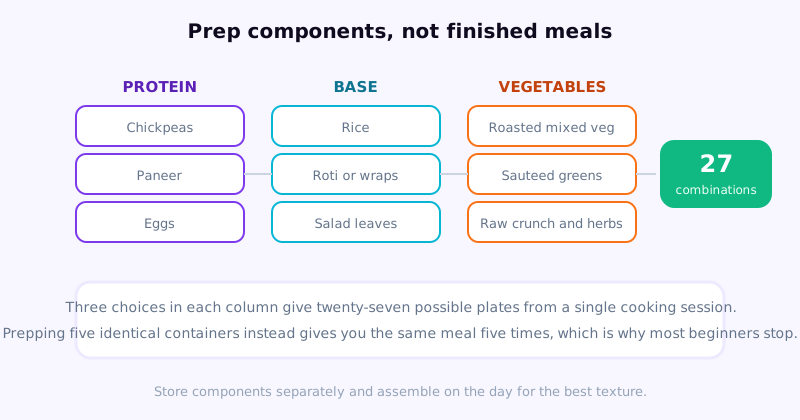
The most useful components to prep as a beginner are versatile building blocks rather than finished meals — items that can be assembled into different combinations throughout the week so eating the same prep doesn't feel repetitive. Cooked grains are the best starting point: a large pot of rice, quinoa, or barley keeps for five days in the fridge and pairs with almost anything. Roasted vegetables are equally versatile: any combination of vegetables tossed in oil and salt and roasted at high heat for 20–30 minutes works as a side dish, a bowl component, or mixed into pasta or eggs. These two together form the base of multiple different meals.
Pre-cooked proteins — baked chicken thighs, hard-boiled eggs, cooked mince, or baked tofu — reduce evening cooking to reheating rather than starting from scratch. Wash and dry salad leaves and store them with a paper towel in a container; they stay fresh for four to five days and are ready to serve without any effort. A jar of dressing or sauce made in advance is one of the highest-value things to prep: the same grain and vegetable combination can become a Mediterranean bowl with lemon tahini or an Asian bowl with sesame-soy dressing. Pre-portioned snacks — nuts, cut fruit, carrot sticks — eliminate the moment when you're hungry and reach for whatever's easiest.
Running Your First Prep Session
Planning is the step that determines whether the session is efficient or chaotic. Before shopping, decide on three to four meals for the week and write a shopping list that covers only what you need for those specific recipes. Look for recipes that share ingredients — if both a salad and a grain bowl use chickpeas and cucumber, you're buying and prepping each once rather than twice. When you bring groceries home, wash all produce immediately: it's ready to use without any extra step midweek, which removes a surprising amount of friction.
On prep day, start with the items that take longest: grains on the stove and vegetables in the oven can both be cooking simultaneously while you use the time to chop, portion, and assemble other components. This parallel working reduces total session time considerably. Pack everything into clearly labelled containers with the contents and date; when you open the fridge on Wednesday, you don't need to remember what's in each container or how old it is. Prep sessions that run more than two hours are usually trying to do too much — a 60–90 minute session that produces grains, a batch protein, roasted vegetables, and a sauce covers most of the week's needs.
Storage for a Successful Week
How you store prepped food has a direct effect on whether you actually eat it. Clear containers at eye level in the fridge mean you see your prepared food every time you open the door, which makes reaching for it the path of least resistance. Opaque containers pushed to the back of the fridge are how good prep gets forgotten until it's too old. Cooked proteins keep for three to four days reliably; grains and roasted vegetables last five days. Hard-boiled eggs in their shells last a week. If you've made more than you'll use in four days, freeze portions before they hit that limit rather than after — frozen at the right point, the quality on reheating is close to fresh.
Keeping sauces, dressings, and anything moisture-heavy in separate containers prevents sogginess. A salad with dressing already on the leaves is unpleasant by day two; the same salad stored dry with dressing in a small side jar is still fresh and crisp. This applies to grain bowls, wraps, and anything with a wet component: keep it separate until the moment of eating. A consistent set of stackable containers makes it easy to keep the fridge organised and see at a glance what you have prepared, which is what makes the habit durable rather than something you restart every few months.
Essential Containers for Meal Prep
The right containers are the backbone of a successful meal prep routine. Poorly chosen containers lead to leaks, soggy food, and meals that don't survive the commute. Investing in a consistent set pays dividends every single week, and you don't need many — a small curated collection covers almost every scenario.
- Glass containers with locking lids: Oven-safe, microwave-safe, and stain-resistant — ideal for meals you'll reheat in the container
- Compartment containers: Keep proteins, grains, and vegetables separate until eating — prevents sogginess for assembled meals
- Wide-mouth mason jars: Perfect for overnight oats, layered salads, and smoothie ingredients — stack compactly in the fridge
- Stainless steel lunchboxes: Durable and leak-proof for on-the-go meals; bento-style inserts keep components separate
- Freezer-safe containers: Square or rectangular shapes stack efficiently in the freezer — avoid round containers which waste freezer space
- Small condiment containers: Separate dressings, sauces, and dips travel leak-free and keep food crisp until the last moment
Batch Cooking Proteins: The Weekly Foundation
Protein is the most time-consuming component of any meal — and the most impactful thing to have pre-cooked. With two or three proteins prepared at the start of the week, assembling a complete meal becomes a five-minute task. The key is choosing proteins that reheat well and pair with multiple different flavour profiles.
- Oven-baked chicken thighs: Season simply with salt, pepper, and olive oil; bake at 200°C for 30 minutes — works in salads, wraps, pasta, and grain bowls
- Sheet-pan salmon: Bake a full side of salmon in 15 minutes; flakes into pasta, salads, and rice dishes throughout the week
- Cooked ground meat: Season lightly when batch cooking so it adapts — add Italian herbs for pasta, cumin for tacos, soy for stir fry
- Hard-boiled eggs: Cook 6–8 at once; they keep in the fridge for a week and are a fast protein for any meal or snack
- Canned and dried legumes: Tinned chickpeas, lentils, and black beans require zero cooking — just drain, rinse, and season
- Tofu pressing and marinating: Press firm tofu for 30 minutes, cube and marinate overnight, then bake — keeps for 5 days and absorbs flavour beautifully
Frequently Asked Questions
How long does meal prepped food last in the fridge?
Cooked proteins (chicken, fish, ground meat) last 3–4 days refrigerated. Cooked grains like rice and quinoa last 4–5 days. Roasted vegetables last 4–5 days. Hard-boiled eggs (in shell) last up to a week. Salad greens, washed and dried, last 4–5 days if stored with a paper towel to absorb moisture. When in doubt, freeze anything you won't eat within four days — it reheats just as well.
What foods are best suited to meal prepping?
The best meal prep foods are those that hold up well over several days without deteriorating. Grains (rice, quinoa, barley) are ideal — they reheat perfectly and pair with almost anything. Roasted and stir-fried vegetables keep their texture well. Cooked lentils and beans are excellent. Hard proteins like baked chicken and tofu reheat without turning rubbery. Avoid prepping delicate fish, leafy salad with dressing already added, or anything with avocado, which browns quickly.
Do you need special containers for meal prep?
You don't need expensive containers to start. Any airtight, microwave-safe containers work. That said, investing in a consistent set of glass containers with locking lids makes a real difference — they're easier to stack, oven-safe, and don't stain. Compartment containers that keep food components separate are worth getting if you find your lunches getting soggy. Start with what you have and upgrade gradually based on what you actually need.
How do you avoid getting bored of meal prepped food?
The key is prepping versatile components rather than complete identical meals. A batch of cooked rice, roasted vegetables, and spiced chickpeas can be assembled into a bowl, stuffed into a wrap, or served as a side with eggs — three different meals from the same prep. Vary your sauces and dressings, which transform the flavour profile of the same base ingredients. Swap the cuisine angle mid-week: same chicken, but Monday it's in a curry and Thursday it's in a Mexican bowl.
How do you meal prep when cooking for just one person?
Cooking for one is actually where meal prep shines most — you make one batch and eat from it all week without the pressure of serving others. Scale recipes to half or quarter quantities, or make full batches and freeze portions you won't eat by day 4. Focus on 2–3 protein options and 2–3 grain and vegetable components rather than whole separate meals. Mix and match throughout the week for variety without cooking multiple separate dishes.
How do I start meal prep if I only have one hour?
Choose one grain, one protein, one tray of vegetables, and one sauce. Start the grain first, put the vegetables in the oven, and cook the protein while both are working. Store the components separately so they can become bowls, wraps, or side dishes instead of one repeated meal. A one-hour session that covers three or four meals is more useful than an ambitious plan you cannot repeat.
What is the easiest meal to prep for a busy week?
Begin with a flexible grain bowl: cooked rice or quinoa, roasted vegetables, a protein such as lentils, eggs, chicken, or tofu, and a dressing kept in a separate jar. Each component stores well and can be changed with a different sauce or wrap. This format is easier to adjust than five identical containers and works for both lunches and quick dinners.
Meal prep is a skill that improves with practice. Your first session might feel slow and unfamiliar, but by week three you'll have a rhythm that makes healthy eating feel almost effortless. Start with just two or three prepped items this week, build gradually, and adjust based on what your household actually eats. The goal isn't perfection — it's progress toward a week that feels more in control.