Mindful Productivity: Work Smarter Without Burning Out
Accomplish more while stressing less with mindful work strategies
For informational purposes only. This content reflects general guidance; individual results and circumstances vary.

Key Takeaways
- Attention is the limiting resource. Working longer rarely compensates for scattered focus.
- Fewer decisions preserve capacity. Routines remove choices that quietly drain energy.
- Deliberate technology use matters. Notifications fragment concentration more than task volume does.
- Reflection closes the loop. A short end-of-day review shows what actually worked.
The Mindful Productivity Revolution
Traditional productivity focuses on doing more, faster. Mindful productivity focuses on doing the right things with full presence and intention. This approach leads to better results, less stress, and greater satisfaction.
Core Principles of Mindful Productivity
Quality Over Quantity
Focus on completing fewer tasks with higher quality rather than rushing through many tasks poorly.
Single-Tasking Mastery
Switching between tasks makes it harder to keep track of details. Focus on one task at a time and reduce interruptions when the work requires concentration.
The Pomodoro Technique:
- Work for 25 minutes on one task
- Take a 5-minute break
- Repeat 4 cycles, then take a 30-minute break
Mindful Breaks
Regular breaks aren't just rest—they're essential for maintaining peak performance and creativity.
Effective Break Activities:
The FOCUS Method
A practical framework for implementing mindful productivity:
Filter Your Tasks
Use the Eisenhower Matrix to categorize tasks:
Do immediately
Schedule these
Delegate if possible
Eliminate these
Organize Your Environment
Create a distraction-free workspace that supports focus:
- Clear physical clutter from your desk
- Close unnecessary browser tabs and apps
- Use noise-canceling headphones if needed
- Set your phone to "Do Not Disturb" mode
Commit to Presence
Before starting each task, take three deep breaths and set an intention to be fully present.
Mindful Work Mantras:
"I am fully present with this task"
"I work with calm focus and clarity"
"Each moment of work is an opportunity for excellence"
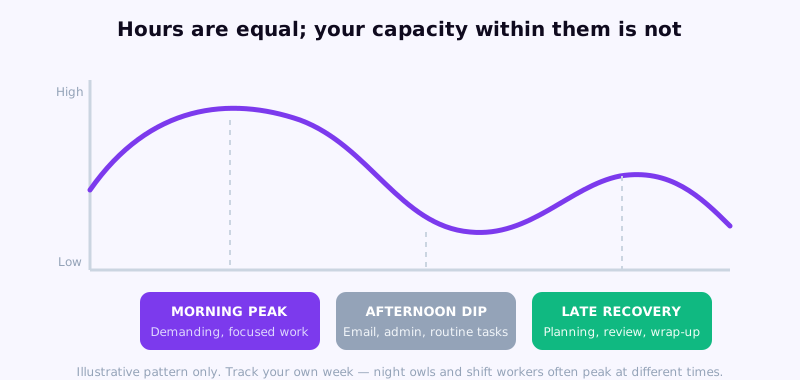
Use Energy Rhythms
Align your most important work with your natural energy peaks:
Sustain with Self-Care
Productivity without self-care leads to burnout. Include these daily:
Mindful Technology Use
Digital Boundaries
- Check email only at designated times (e.g., 9 AM, 1 PM, 5 PM)
- Turn off non-essential notifications
- Use website blockers during focus sessions
- Practice a "digital sunset" 1 hour before bed
Helpful Apps & Tools
- Forest or Focus apps for concentration
- RescueTime for time tracking
- Todoist or Any.do for task management
- Headspace or Calm for meditation breaks
Measuring Mindful Productivity
Track these metrics weekly to assess your progress:
Task Completion Rate
Percentage of planned important tasks completed
Stress Level
Rate your daily stress on a scale of 1-10
Energy Level
How energized you feel at the end of each day
Work Satisfaction
How satisfied you feel with your work quality
The End-of-Day Reflection Routine
Most productivity advice focuses on how to start the day, but how you close it matters just as much. A short end-of-day reflection — no more than 10 minutes — creates a clear boundary between work and rest, helps you learn from what happened, and sets you up to hit the ground running the next morning. Without this closing ritual, the workday bleeds into evening and your brain stays in low-level work mode even when you're trying to relax.
The goal is not a lengthy review but a brief, honest checkpoint that acknowledges what went well, what didn't, and what tomorrow's single most important task will be.
- Review your three priorities: Did you complete the important tasks you set out to do? If not, what got in the way? This builds pattern recognition over time.
- Note one win: Deliberately acknowledging one thing you did well — however small — prevents the cognitive bias of only remembering what went wrong.
- Identify tomorrow's single most important task: Write it down before you close up. When you sit down tomorrow, you start with purpose rather than inertia.
- Clear your physical and digital workspace: A clean desk and a closed browser are signals to your brain that work is genuinely finished for the day.
- Set a firm shutdown phrase: Cal Newport's method of saying "shutdown complete" out loud sounds odd but effectively trains your brain to stop ruminating on unfinished work.
Eliminating Decision Fatigue
Every decision you make — from what to wear to which email to answer first — draws on a finite daily reserve of mental energy. By midday, many people experience decision fatigue: the quality of their choices degrades, they default to the easiest option, and small choices feel disproportionately draining. Mindful productivity means protecting your decision-making capacity by designing your life so that fewer unimportant decisions need to be made at all.
The goal is not to become robotic but to automate the trivial so your cognitive resources are available for the work that actually matters.
- Plan meals in advance: Deciding what to eat in the moment is a daily drain — batch-planning meals for the week removes dozens of small decisions at once.
- Standardise your morning routine: When the first hour of your day runs on autopilot, you arrive at your first real task with your decision-making capacity intact.
- Use templates for recurring work: Email responses, meeting agendas, and project outlines can often be templatised — starting from a template rather than a blank page is a genuine time and energy saver.
- Batch similar decisions together: Process all emails in one sitting, make all administrative decisions in a single block, and handle all approval requests at once rather than being interrupted throughout the day.
- Pre-commit to tomorrow's first task today: Deciding what to work on when you're already at your desk wastes your freshest cognitive energy on logistics rather than execution.
Frequently Asked Questions
What is mindful productivity?
Mindful productivity means approaching your work with intention — choosing what to focus on deliberately rather than reacting to whatever's loudest. It combines getting things done with genuine awareness of your energy, wellbeing, and limits. The goal is sustainable output, not maximum output. It's the opposite of grinding through tasks while disconnected from how you actually feel.
How do you stay focused without overdoing it?
Work in focused sessions (25–90 minutes depending on the task), then take a real break — away from screens. Honor your natural energy peaks by scheduling deep work when you feel sharpest, and lighter tasks when you don't. Set a clear stopping point for the workday and protect it. Sustainable focus requires recovery built into the rhythm, not added as an afterthought.
What are the signs of burnout to watch for?
Early warning signs include chronic exhaustion that rest doesn't fix, growing cynicism about your work, difficulty concentrating, reduced output despite working more hours, emotional detachment, and physical symptoms like headaches or frequent illness. Burnout doesn't arrive suddenly — it builds over weeks or months of ignored depletion signals. Catching it early is far easier than recovering from full burnout.
How is mindful productivity different from hustle culture?
Hustle culture glorifies busyness, long hours, and pushing past your limits as virtues in themselves. Mindful productivity treats energy as a resource to manage wisely, not exhaust. It measures success by meaningful output and wellbeing, not hours logged. The key difference: hustle culture treats rest as weakness; mindful productivity treats rest as essential infrastructure for sustained performance.
How do you take effective breaks at work?
Effective breaks are genuinely restorative — not just switching from one screen to another. Step away from your desk, take a short walk, make a drink, do some light stretching, or simply sit outside for a few minutes. Even a 5–10 minute break that involves movement or nature has measurable benefits for focus and mood. Scrolling social media during a break typically doesn't restore your focus — it drains it further.
Start Your Mindful Productivity Journey
Begin tomorrow by choosing just one principle to implement. Small, consistent changes lead to remarkable transformations.