Packing Hacks: Pack Light, Pack Smart
Pack smarter, lighter, and faster with these tried-and-tested travel hacks

Packing well is a skill that improves with every trip. Over-packers struggle with heavy bags, excess baggage fees, and the exhausting logistics of moving around with too much stuff. Under-packers feel underprepared and stressed. The goal is to bring exactly what you need — no more, no less — in a way that stays organised throughout the trip. These hacks will help you get there.
Key Takeaways
- Build the list around the actual trip. Packing for every hypothetical scenario is what creates excess weight.
- Rolling and compression save space. How you pack matters as much as what you pack.
- Cubes make bags searchable. Organising by category avoids unpacking everything to find one item.
- Climate changes the list, not the method. The same system adapts to different destinations.
Build the Packing List Around the Trip
Start with the itinerary rather than the suitcase. Write down the weather, dress requirements, planned activities, laundry access, luggage allowance, and the longest time between shops or accommodation. Then create three lists: must have, useful if space allows, and leave behind. Pack the must-have list first and do not let a “just in case” item displace medication, documents, chargers, or weather-appropriate clothing.
- Use an outfit count: count planned days and activities, then repeat compatible layers instead of packing one outfit per day.
- Check the heaviest items: weigh the packed bag before leaving and compare it with the airline or transport limit.
- Keep one arrival set accessible: place documents, medication, charging equipment, and the first outfit where they can be reached without unpacking.
- Leave capacity for the return: keep a little space or pack a foldable bag if souvenirs or laundry will change the load.
The Mindset Shift: Pack for the Trip, Not for Every Scenario
Most overpacking comes from packing defensively — bringing items for scenarios that might occur rather than packing for what the trip actually involves. The mental shift is from "what if I need this?" to "what will I actually use?" Before anything goes in the bag, it should have a planned use on a specific day. Vague possibilities — "maybe I'll go somewhere fancy," "in case it rains a lot," "just to have options" — are how suitcases fill up with things that never leave the bag.
Planning outfits rather than individual items is the most effective practical technique. Lay out complete combinations — top, bottom, shoes — for each day of the trip. Anything that doesn't form part of a working outfit gets left behind. Wearing your heaviest and bulkiest items on travel days removes them from the bag entirely: the thick-soled shoes, the heaviest jacket, the bulkiest knitwear go on your body rather than taking up half the bag. For trips over a week, planning one laundry stop rather than bringing enough clothes to avoid it entirely halves your clothing load.
Rolling, Folding, and Compression
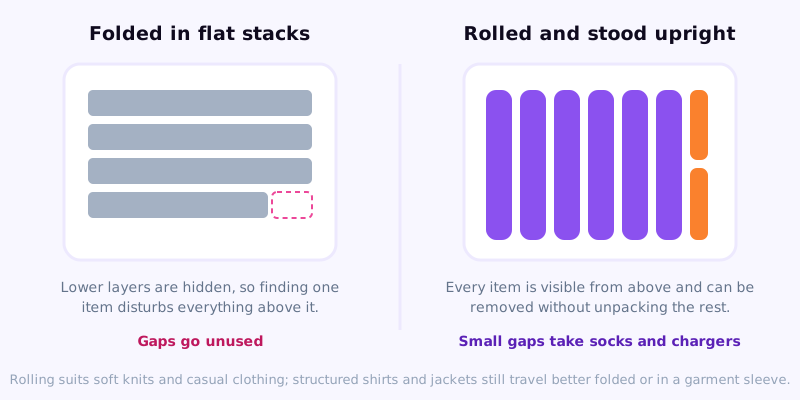
Rolling is the best method for most casual clothing: t-shirts, jeans, soft trousers, and any jersey or knit fabric roll into tight cylinders that fit into small spaces and resist wrinkles far better than folding. The technique is to lay the item flat, fold in the sides if needed to make a consistent width, then roll firmly from one end. Stood on end in the bag rather than stacked, rolled clothes let you see every item at a glance without disturbing the others — the main practical advantage over folding.
Formal wear is the exception: dress shirts, blazers, and structured items fold flatter than they roll and should be stacked rather than rolled to preserve their shape. Compression bags or compression-style packing cubes are worth using for bulky items like thick fleeces, knitwear, and down jackets — they compress the air out of the fabric and can halve the volume of items that would otherwise eat up disproportionate space. Regular packing cubes don't compress significantly but add enormous value for organisation: assign each cube a permanent category and unpacking and repacking at hotels becomes fast and automatic.
Packing Your Bag Efficiently
Weight distribution matters more than most people realise, especially for backpacks. Heavier items — shoes, toiletry bags, electronics — belong as close to your back as possible and in the middle of the bag's height rather than at the bottom. This keeps the centre of gravity close to your body, which makes the bag significantly easier to carry than one with all the weight at the bottom pulling away from you. Shoes should always be filled: each shoe is a container that fits socks, small chargers, or rolled accessories — treating them as dead space is a missed opportunity.
Internal pockets should be assigned specific purposes rather than used randomly. A consistent system — chargers and adapters in one pocket, documents and cards in another, toiletries accessible at the top — means you can find anything immediately without unpacking. This matters particularly at security, where you need documents and electronics quickly, and during the trip when you're moving between accommodation. A toiletry bag that sits at the very top of the main compartment is accessible without disturbing the rest of the bag's organisation.
What to Pack: Category by Category
Documents are the most critical category and the one that benefits most from redundancy. Your passport, a printed copy of every booking confirmation, travel insurance documents, and emergency contact numbers should all be physically present. Scan everything to cloud storage as a backup accessible from your phone. Keep your passport and main documents on your person during travel days rather than in checked luggage. A travel card or small amount of local currency for arrival covers the gap before you reach an ATM.
For electronics, the practical limit is one universal adapter (not a separate adapter per device), a power bank large enough for a full phone charge, and only the devices you will actually use daily. A single set of good headphones covers flights, ground transport, and hotel rooms. Toiletries benefit from buying solid formats where possible — shampoo bars, solid conditioner, and solid soap eliminate liquids from your bag entirely, bypass airport liquid restrictions, and are lighter than bottles. For anything liquid, 100ml travel-sized bottles are the practical limit for carry-on. The clothing formula that fits almost any trip of up to two weeks: five tops, two bottoms, one layering piece, one versatile shoe, and one pair of sandals or trainers — supplemented by planned laundry if the trip is longer.
Travelling Carry-On Only
Carry-on-only travel is achievable for most trips up to two weeks with some planning, and the benefits — no baggage fees, no waiting at carousels, no risk of lost luggage — compound on every trip. The first requirement is knowing your airline's exact carry-on dimensions, which vary significantly between carriers and are enforced more or less strictly by route. Low-cost European carriers measure bags at the gate; long-haul carriers on the same trip may not. Checking before you pack prevents an expensive surprise at check-in.
The personal item allowance (the smaller bag that goes under the seat) is often underused. A structured tote or small daypack counts as a personal item on most airlines and holds considerably more than a soft bag of the same external size. Combined with the main carry-on overhead, you have a substantial total volume. The toiletry edit is where most carry-on attempts fail: decant only what you will use across the actual number of days you're away, not a full bottle of everything you use at home. On a 10-day trip, doing laundry at the midpoint reduces clothing to five days' worth, which is manageable in any cabin bag with room to spare.
The Packing Cubes System: Organise by Category
Packing cubes are one of the most practical travel investments you can make. Rather than treating them as a loose extra, build a consistent system around them so packing becomes automatic on every trip. Assign each cube a permanent category and you'll always know exactly where everything is — no rummaging, no repacking mid-trip.
- Tops cube: All t-shirts, shirts, and tops in one cube — rolled vertically so you can see every item at a glance
- Bottoms cube: Trousers, shorts, and jeans — folded flat or rolled depending on fabric weight
- Underlayer cube: Underwear, socks, and light base layers in a small compression cube
- Accessories cube: Scarves, belts, sunglasses case, and travel adapters — the miscellaneous category that otherwise scatters
- Dirty laundry cube: A lightweight mesh cube for worn items keeps clean and dirty clothes completely separated
- Compression cubes for bulk: Use compression-style cubes for thicker items like hoodies and knitwear — they halve the volume without a vacuum
Packing for Different Climates
Packing for heat is straightforward — packing for cold, variable, or mixed-climate destinations is where most travellers over-pack. The key is building around layers rather than single heavy items, and choosing fabrics that handle temperature swings without taking up excessive space.
- Hot climates: Linen and lightweight cotton breathe best — avoid synthetics in high humidity; pack a thin cover-up for air-conditioned spaces
- Cold climates: Thermal base layers worn on travel day replace multiple bulky items; one mid-layer fleece and one outer shell covers most conditions
- Variable weather: The 3-layer system (base, mid, outer) is more packable than one thick coat and adapts to any temperature
- Rainy destinations: A packable waterproof shell compresses to the size of a water bottle and weighs almost nothing
- Mixed seasons in one trip: Pack for the coldest part and remove layers — don't try to pack two complete wardrobes
- Merino wool is your friend: Odour-resistant, temperature-regulating, and wrinkle-resistant — one merino top can serve for three or four days
Frequently Asked Questions
How do you pack a week's worth of clothes into a carry-on?
Choose versatile, neutral-coloured clothing that mixes and matches so you get multiple outfits from fewer items. Use the clothing formula: 5 tops, 2 bottoms, 1 layer, and 1 versatile pair of shoes. Plan to do laundry mid-trip if it's a 7+ day trip. Roll everything and use packing cubes. Wear your bulkiest items on travel days. Avoid packing "just in case" items — they stay in the bag and waste space.
Is rolling or folding clothes better for packing?
Rolling is generally better for most clothing types — it's more space-efficient and reduces wrinkles in casual items like t-shirts, jeans, and soft fabrics. Folding flat is better for formal shirts, suits, and structured items that crease when rolled. The best approach is a hybrid: roll casual everyday items, fold anything structured or formal. Using packing cubes alongside either method keeps everything compressed and organised.
What do people most often forget to pack that they should always bring?
The most commonly forgotten items are: a universal power adapter (especially for international trips), a reusable water bottle, physical copies of key documents (accommodation addresses, insurance policy number), a basic first aid kit with pain relief and plasters, and a small day bag or foldable tote for daily excursions. Also frequently forgotten: earplugs (invaluable on planes and in hostels) and a small padlock for hostel lockers.
How do you pack shoes without taking too much space?
Limit yourself to two pairs of shoes maximum — one versatile walking shoe and one for evenings or special occasions. Pack shoes in individual shoe bags or shower caps to keep soles away from clothing. Fill the inside of each shoe with socks, a charger, or other small items to use that space. Place shoes at the bottom of your bag (closest to the wheels or base) for best weight distribution. Wear your bulkiest pair on travel days.
What are the packing essentials for international travel specifically?
International travel requires a few extras beyond domestic trips: a universal power adapter (check destination plug type), your passport and a photocopy stored separately, travel insurance documents saved offline, any required or recommended vaccinations and a prescription letter for medications, local currency for arrival (ATM fees aside), and a SIM card or international data plan arranged before departure. Download offline maps for your destination before you fly.
The best packers are the ones who've over-packed before — they've learned exactly what they never use and edited it out. Build your personal packing list from real trips, noting what stayed in the bag the whole time. Your list will get shorter and more precise with each trip, until packing feels effortless rather than stressful.