How to Save Money on Groceries in India
Smart shopping strategies to cut your grocery bill without cutting corners

Practical tips to cut your grocery bill without compromising on nutrition
Key Takeaways
- Where you shop changes the bill. Local markets, kirana stores and online platforms price differently for the same basket.
- Seasonal vegetables are the largest lever. In-season produce is usually cheaper and better quality.
- Plan before buying. A list built around planned meals limits duplicate and impulse purchases.
- Bulk buying only helps if you use it. Buy staples in bulk, not perishables.
Why Grocery Bills Are Rising in India
Food inflation in India has been a persistent reality for most households over the last few years. Tomatoes that cost ₹20 per kg can suddenly jump to ₹100. Onion prices double in a matter of weeks. Even staples like atta, dal, and cooking oil have seen steady price increases driven by supply chain issues, fuel costs, and global commodity prices.
Grocery spending varies widely across Indian households depending on the city, family size, dietary habits, and shopping choices. In metros like Mumbai, Bengaluru, and Delhi, the same shopping list can cost considerably more than in smaller cities. Treat your own receipts as the most useful baseline and look for the categories where your household has the most room to save.
The good news: with a few deliberate habits, most families can meaningfully cut their grocery spending without eating less, switching to lower-quality food, or spending hours hunting for deals. The key is shopping smarter, not cheaper.
Shop at the Right Places
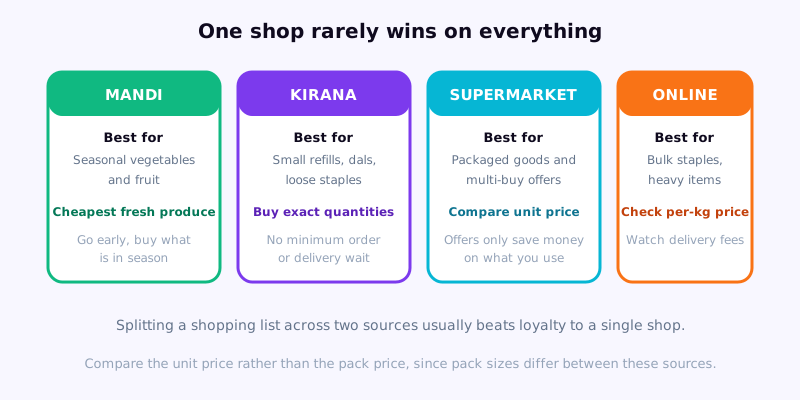
Where you shop has a bigger impact on your bill than almost any other factor. Most Indians overpay simply by defaulting to the most convenient option.
- Local sabzi mandis over supermarkets: Fresh vegetables and fruits at your local mandi can be cheaper than at branded supermarkets, although prices vary by season and location. Compare a few typical items before changing your routine.
- Weekly haats for the best prices: Many cities and towns still have weekly markets (haats) where farmers sell directly. Prices are lower and you often get a better variety of seasonal produce. Ask locals when and where the nearest one is held.
- Wholesale markets for staples: Cities like Delhi's Khari Baoli, Mumbai's Vashi APMC, or local wholesale grain markets may offer better prices on dal, rice, atta, and spices. A monthly trip only makes sense if the travel and storage costs work for your household.
- Shop on weekday mornings: Vendors at mandis and local shops are more willing to negotiate on price in the morning when they want to move fresh stock. Weekends attract more buyers, which means less bargaining power for you.
- Use supermarkets selectively: Big supermarkets are great for packaged goods, personal care, and branded items where prices are more uniform. But for fresh produce and loose grains, the local option usually wins on both price and freshness.
Plan Before You Buy
Impulse buying is the silent killer of grocery budgets. Walking into a store or opening a quick-commerce app without a clear list leads to overspending every single time. A small investment of 15 minutes in meal planning at the start of each week can save you hundreds of rupees.
- Plan meals for the week before you shop: Sit down on Sunday and roughly plan breakfasts, lunches, and dinners for the week. You do not need to be rigid — even a rough framework prevents the "what do I cook tonight" panic that leads to expensive last-minute decisions.
- Write a shopping list and stick to it: A written list (even a notes app on your phone) dramatically reduces impulse buys. If it is not on the list, it does not go in the cart unless it is genuinely a good deal on something you will definitely use.
- Check your fridge and pantry first: Before writing your list, do a quick audit of what you already have. How many times have you bought onions only to find a full bag at the back of the vegetable drawer? This simple check helps prevent duplicate purchases.
- Plan around what is on sale: If your store has coriander at half price this week, build a few dishes around it rather than buying it out of habit at full price elsewhere.
- Avoid shopping when hungry: This is well-documented psychology — hungry shoppers buy more, especially snacks and packaged foods. Eat something before you go grocery shopping.
Seasonal Vegetables: Your Biggest Money Saver
In India, buying vegetables in season can reduce the cost of your shopping because supply is higher and quality is often better. The exact saving depends on the vegetable, market, city, and week. Off-season vegetables may be imported, stored in cold storage, or harder to source, which can raise the price.
Here is a rough seasonal guide for Indian vegetables:
- Winter (November–February): Cauliflower, peas, carrots, radish (mooli), spinach (palak), methi, mustard greens (sarson), capsicum, tomatoes, beetroot. This is a good time to compare prices and use the vegetables that are plentiful in your market.
- Summer (March–June): Bitter gourd (karela), okra (bhindi), ridge gourd (turai), bottle gourd (lauki), raw mango, drumstick (sahjan). Prices on these are low during peak summer — use this time to cook lauki and bhindi-based dishes more often.
- Monsoon (July–October): Colocasia (arbi), yam, cluster beans (guar phali), raw banana, corn. Monsoon is trickier because heavy rains disrupt supply and prices spike for many vegetables. This is when frozen vegetables become especially cost-effective.
The trick is versatility — learn a few different ways to cook the same seasonal vegetable so you do not get bored. Spinach can be palak paneer one day, palak dal another, and a palak paratha the third day. Same vegetable, very different meals.
Smart Substitutions to Save Money
Many Indian households overspend on premium ingredients when affordable alternatives can work just as well in everyday dishes. A few strategic substitutions can meaningfully reduce your grocery bill.
Dal over paneer every day
Paneer can be expensive compared with dal, although prices vary by city and shop. Dal (moong, masoor, chana, or toor) is a flexible staple for everyday meals. Compare current local prices and use the option that suits your household's taste and budget.
Frozen vegetables during off-season
Frozen peas, corn, and mixed vegetables are convenient, easy to portion, and useful when fresh produce is expensive or unavailable. Compare the current packet price with fresh produce in your area, and keep a few bags as a practical backup.
Substitute expensive ingredients creatively
Cashews in gravy can be replaced with melon seeds (magaz) or soaked and blended almonds for a fraction of the cost. Dried fenugreek (kasuri methi) is far cheaper than buying fresh methi bunches when you only need a garnish. Homemade curd is roughly one-third the cost of store-bought flavoured yogurt.
Eggs over other proteins for breakfast
Egg prices vary by location, but they are often a convenient, affordable ingredient for breakfast. Replacing a bread-and-butter breakfast with a two-egg preparation may suit some budgets; choose based on your household's preferences and dietary needs.
Reduce Food Waste
Food wasted at home represents money that was spent and then thrown in the bin. Reducing that waste is one of the simplest ways to lower your effective grocery cost without changing every item you buy.
- FIFO in your fridge: First In, First Out. When you bring home fresh produce, put the new items at the back and move older ones to the front. This simple habit ensures you always use the older items first and dramatically cuts how much goes bad.
- Use vegetable peels: Bottle gourd peel sabzi, potato peel chips, and watermelon rind curry are common in traditional Indian cooking for a reason — they taste good and waste nothing. Try making a mixed peel thoran or stir-fry with your week's peels.
- Transform leftovers: Leftover rice becomes fried rice or rice tikki. Leftover dal becomes dal paratha. Leftover roti gets turned into churma or a quick roll with sabzi. Indian cuisine has centuries of built-in leftover wisdom — use it.
- Freeze bread before it goes stale: Bread has a short shelf life, especially in Mumbai's humidity. Slice and freeze it when you buy it. Remove slices as needed — they toast from frozen just as well.
- Wilting vegetables go into soup or dal: When vegetables are past their prime but not spoiled, they are perfect for boiling into a mixed vegetable soup, adding to dal, or making a vegetable pulao. Do not let a slightly soft tomato or limp spinach go to waste.
Buy in Bulk (Wisely)
Buying in bulk saves money — but only for the right items. Buying the wrong things in bulk leads to spoilage, which is the opposite of saving.
- Best items to buy in bulk: Rice, all varieties of dal, atta (wheat flour), cooking oil, whole spices (jeera, black pepper, coriander seeds, cloves), sugar, salt, and dry coconut. These have long shelf lives and price per kg drops significantly when bought in 5–10 kg quantities.
- Never buy in bulk: Fresh vegetables, fruits, bread, milk, and most dairy. These have short shelf lives and bulk buying typically leads to waste that cancels any savings.
- How much you actually save: Buying basmati rice or dal in larger quantities from your local kirana or wholesale store is consistently cheaper per kg than buying small packets from a supermarket.
- Storage is critical: Invest in good airtight containers for bulk staples. Rice and dal stored improperly invite insects. A one-time purchase of quality storage jars pays for itself quickly through reduced wastage.
- Buy spices from your local kirana, not supermarket packets: Loose spices from a trusted kirana or spice shop are significantly cheaper than the branded sachets. You also get fresher stock because the turnover is higher.
Frequently Asked Questions
What is the cheapest nutritious food in India?
Dal (lentils) tops the list — affordable, high in protein and fibre, and endlessly versatile. Eggs come next for non-vegetarians. Seasonal vegetables like spinach, pumpkin, and bottle gourd are nutritious and cheap in season. Whole grains like bajra and jowar are excellent value and more nutritious than refined atta. Curd (homemade) is another cost-effective, probiotic-rich staple.
How much should an Indian family of 4 spend on groceries?
As a rough planning exercise, a family of four in a Tier-1 city might compare its spending with a monthly range such as ₹6,000–9,000 for vegetarian groceries or ₹7,000–11,000 when buying meat a few times a week. These figures vary substantially by city, diet, brand, household size, and date; spending more does not by itself prove that a family is wasting food.
Is Zepto or Swiggy Instamart cheaper than local stores?
For most items, no. Quick-commerce apps are convenient but typically price products at MRP or close to it, plus delivery charges. They are best for emergency restocking of packaged items, not your primary grocery shopping. Your local kirana will almost always be cheaper on daily staples, and the sabzi mandi will beat them significantly on produce. Use these apps as a backup, not your main source.
How to save money when you cook non-veg?
Compare the per-kilogram price of whole chicken with pre-cut pieces at your local shops; whole birds may offer better value, but the difference varies by seller and date. Buy fish that is in season locally when it suits your meals, and make curries or biryanis stretch with vegetables. Use chicken bones for stock if you will prepare and store it safely.
Best apps to find grocery deals in India?
BigBasket and Blinkit regularly run sales on staples and have loyalty programs worth using. JioMart often has competitive pricing on packaged goods. CashKaro and Magicpin offer cashback on purchases from various grocery retailers. D-Mart's in-store prices are consistently low but the app is mainly for delivery. For fresh produce, no app beats physically shopping at your local mandi.
Saving money on groceries in India is less about deprivation and more about awareness. When you know which season brings which vegetables, which stores price staples fairly, and how to plan a week of meals before you shop, the savings can add up. Track your own spending for a month, then test habits such as meal planning, shopping lists, seasonal buying, and sensible bulk purchases to see which changes actually help your household.