Solo Travel Tips: Travel Alone Safely and Confidently
Everything you need to plan a safe, rewarding solo adventure

Solo travel is one of the most transformative things you can do. The freedom to go exactly where you want, at your own pace, without compromise or negotiation is genuinely liberating. It builds self-reliance, confidence, and an ability to navigate unfamiliar situations that stays with you long after you're home. Yes, it can feel daunting at first — but the first solo trip invariably leads to another, and another. These tips will help you start with confidence.
Key Takeaways
- Make the first day simple. Pre-booked arrival and accommodation reduce early stress.
- Destination choice shapes the experience. Some places are considerably easier for a first solo trip.
- Share your plans with someone. Keeping a contact informed is a basic safety habit.
- Solitude takes adjustment. Planning social contact prevents long stretches of isolation.
Make the First Day Deliberately Easy
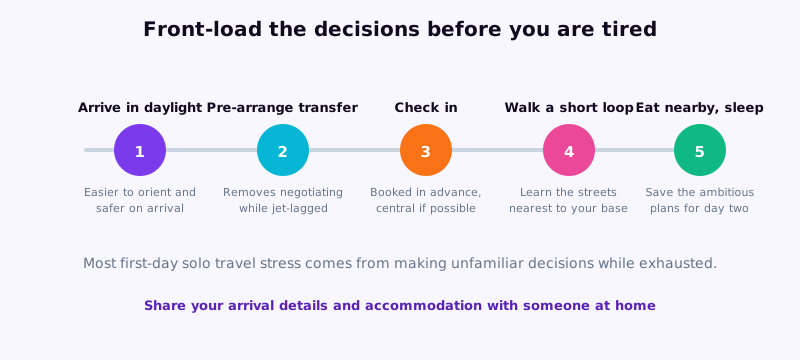
The arrival day carries the most uncertainty, so remove decisions before you leave. Save the accommodation address offline, confirm its check-in time, plan the route from the airport or station, and keep a small amount of local payment available separately from your main wallet. Send one trusted person your arrival plan and a time by which you will check in. After that first night, you can make the itinerary more flexible.
- Use a simple arrival route: prefer an official taxi desk, known ride service, or public transport route you have checked in advance.
- Keep a backup: save the address in local script, carry a power bank, and store copies of key documents separately.
- Set check-in points: message someone after arrival, after reaching accommodation, and whenever your plan changes significantly.
- Leave room to change plans: do not prepay every activity; retain time and money for weather, fatigue, delays, or a safer alternative.
Choosing Your First Solo Destination
- Familiar language or English widely spoken: Removes one layer of navigation challenge on your first trip
- Strong tourist infrastructure: Signage, information, and support systems make independent travel easier
- Safe reputation for independent travel: Check current travel advisories from your government before booking
- Manageable size: A compact city or a well-defined region is easier to navigate alone than a huge country
- Good transport links: Reliable public transport means less dependence on taxis and rideshares
Planning a Solo Trip
- Book accommodation with communal areas: Hostels, guesthouses, and B&Bs with common areas make meeting people easy
- Plan loosely, not rigidly: Block out where you'll be each night but leave days open for discovery
- Research your arrival thoroughly: Know how to get from the airport and where your first accommodation is — remove first-day stress
- Share your itinerary: Leave a copy with someone you trust who knows your rough plan
- Download offline maps: Google Maps and Maps.me work offline — download your destination city before you leave
Staying Safe as a Solo Traveller
- Trust your instincts: If a situation or person feels wrong, leave — you owe no one an explanation
- Stay aware of your surroundings: Put the phone down and observe — know who's near you
- Keep copies of documents separately: Scan passport and insurance to cloud storage so they're always accessible
- Share your location: Let a trusted contact know your rough location via a check-in message each day
- Know your accommodation's address in local script: To show taxi drivers if there's a language barrier
- Travel insurance is non-negotiable: A single medical incident abroad without insurance is financially ruinous
Meeting People When Travelling Solo
- Stay in hostels at least some nights: Communal kitchens and common rooms are where solo travellers naturally connect
- Join free walking tours: Small groups of travellers with a shared interest in the city — social by design
- Take a class or workshop: Cooking class, pottery, surfing lesson — learning alongside others is an easy social setting
- Eat at the bar or communal table: Restaurant seating that encourages interaction rather than isolation
- Travel Facebook groups and apps: Traveller communities often organise meetups in popular destinations
The Mental Side of Solo Travel
- Embrace solitude as a feature: Time alone in a new place is when you hear yourself most clearly
- Make decisions confidently: You will make some wrong turns — navigate them without self-criticism
- Loneliness is temporary: It comes and goes — a good book, a café with a view, or a walk almost always helps
- Be open to improvisation: The most memorable solo travel moments rarely feature in any guidebook
- You're already braver than you think: Choosing to go alone is already the hard part — everything after is adventure
Additional Safety Tips for Women Travelling Solo
Women travelling alone may face destination-specific considerations that go beyond general travel advice. Research the places on your route, check current official travel guidance, and choose precautions that fit your circumstances and comfort level. Practical preparation can reduce avoidable risks without pretending that every destination or traveller has the same experience.
- Research destination-specific norms: Dress codes, local attitudes to solo women, and neighbourhoods to avoid vary enormously by country and city — read recent first-hand accounts from women who've been there.
- Book your first night carefully: Choose well-reviewed accommodation in a central, well-lit area for arrival day — you can explore further afield once you know the city.
- Use ride-hailing apps over street taxis: The driver is traceable and your route is logged — far safer than flagging down an unknown cab, especially at night.
- Have a fake itinerary ready: If asked your plans by strangers, it's perfectly fine to say you're meeting friends later — vagueness about your solo status is a sensible precaution.
- Keep emergency contacts easy to reach: Save local emergency numbers and your embassy contact before arrival — knowing they exist is reassuring even if you never use them.
- Trust discomfort as information: If a person, situation, or location feels wrong, leave immediately without explaining yourself — your instincts are usually right and always worth heeding.
Documenting Your Solo Journey
Travelling alone gives you complete freedom over how and what you record. Without the social dynamics of group travel, you can photograph exactly what interests you, write honestly about how an experience made you feel, and build a record of your solo adventures that becomes genuinely valuable over time — both to you and, if you share it, to others considering their own solo trip.
- Keep a daily travel journal: Even five minutes of notes each evening captures details that photos miss — how a place smelled, what a conversation felt like, what surprised you.
- Photograph the ordinary, not just the landmarks: The café you return to every morning, the view from your hostel window, the market you wandered through — these become more meaningful than the famous sights.
- Use voice memos on the go: Talking your observations into your phone while walking is faster and more natural than stopping to write — transcribe them later.
- Collect physical mementos: Train tickets, coffee receipts, postcards, small handmade items — a small envelope of paper scraps tells the story of a trip better than any photo album.
- Share selectively and intentionally: Social media is optional — consider whether you want to document for yourself or for an audience, and how much you want to be present versus behind a screen.
- Write a trip summary when you return: Within a day or two of getting home, write a paragraph about the whole trip — what changed, what you learned, what you'd do differently. Future you will be grateful.
Frequently Asked Questions
Is solo travel actually safe?
Safety depends on the destination, timing, local conditions, and your own preparation. Choose a trip that matches your experience, research specific areas to be cautious about, keep valuables discreet, share your plans with someone you trust, and check current official travel guidance before booking. If conditions change, adjust your route or plans rather than relying on a general safety promise.
How do you meet people when traveling alone?
The best social infrastructure for solo travellers is hostels — their communal kitchens and common areas are designed for connection. Free walking tours are excellent: small groups of curious travellers exploring the same city at the same time. Taking a class (cooking, surf, language) puts you alongside others with a shared purpose. Eating at bar seating or communal restaurant tables opens conversations naturally. Apps like Meetup and Couchsurfing's events section list local meetups in most cities.
What are the best destinations for solo travelers?
For first-time solo travellers, destinations with strong tourist infrastructure and English widely spoken are easiest: Japan, Portugal, New Zealand, and Thailand consistently rank highly for solo travel. Within India, cities like Goa, Rishikesh, Hampi, and McLeod Ganj have well-developed solo traveller communities. The best destination is ultimately the one that excites you most — any destination becomes manageable with good preparation.
How do you handle emergencies when traveling alone?
Preparation removes most of the panic. Before any trip: save the local emergency number, your country's embassy contact, and your travel insurance emergency line in your phone. Keep your insurance policy number in an accessible place. Share your rough itinerary with someone at home who can act as a point of contact. Have your documents scanned to cloud storage. Know the address and name of your accommodation in local script. If an emergency happens, your insurance company's emergency line is usually your first call.
What are the most important solo travel tips for women specifically?
Research destination-specific norms and dress codes before you go — local customs vary enormously. Book your first night in a central, well-reviewed accommodation rather than the cheapest option on arrival day. Use ride-hailing apps rather than street taxis at night — the route is traceable. It's sensible to be vague about travelling alone with strangers. Trust your instincts immediately — if something feels wrong, leave the situation without explanation. Connect with other women travellers through online communities for destination-specific advice.
How do I plan my first solo trip?
Choose a destination with straightforward transport and accommodation, book the first night in a well-reviewed central location, and plan the arrival route before leaving home. Keep the first day light, save important addresses offline, share your itinerary with someone you trust, and leave the rest of the trip flexible. A manageable first trip builds confidence without requiring every detail to be decided in advance.
How can I enjoy solo travel without feeling lonely?
Build small opportunities for connection into the itinerary: join a walking tour, stay somewhere with a common area, take a class, or eat at a communal table. Balance those activities with time alone so socialising does not become another obligation. Keeping a short daily note or sending photos to someone at home can also make the experience feel shared while preserving your independence.
Solo travel is equal parts planning and letting go. The logistics matter — knowing where you're sleeping and how you're getting there removes the anxiety that would otherwise overshadow experience. But once the basics are sorted, the best solo travel happens when you put the phone away, sit somewhere beautiful, and simply pay attention to where you are. There is nothing quite like it.