Work From Home Productivity Tips for Indians
Set up a productive, comfortable work-from-home routine that actually works

Stay focused, beat distractions, and thrive while working from home in India
Key Takeaways
- A defined workspace matters more than a large one. Even a corner signals the boundary between work and home.
- Plan for power and connectivity gaps. A backup option prevents outages derailing a working day.
- Set expectations with family early. Clear working hours reduce repeated interruptions.
- End-of-day rituals help you switch off. Without a closing routine, work bleeds into the evening.
The Indian WFH Reality
Working from home sounds like a dream: no commute, no office politics, flexible hours. And in many ways it is. But for the majority of Indians working remotely, the experience comes with a set of challenges that no Western productivity blog will mention.
Consider what a typical WFH day looks like for an Indian professional: You are on a morning call and your mother walks in to ask what you want for lunch. Your neighbour's pressure cooker whistles five times through the wall. The vegetable vendor's loudspeaker blares outside. Your relatives call because they assume that since you are at home, you are free. And if you live in a smaller city or town, there is a good chance the power cuts out mid-presentation.
Add to this the reality that most Indian homes — particularly in metro cities — are not designed with a dedicated home office in mind. A family of four living in a 2BHK flat does not have a spare room to convert into a study. Joint family setups mean the house is rarely quiet. The pressure from family members to help with household chores during work hours is real and can be difficult to navigate culturally.
These challenges are not excuses — they are realities. And once you acknowledge them honestly, you can build systems around them rather than pretending they do not exist.
Setting Up Your Workspace in a Small Indian Home
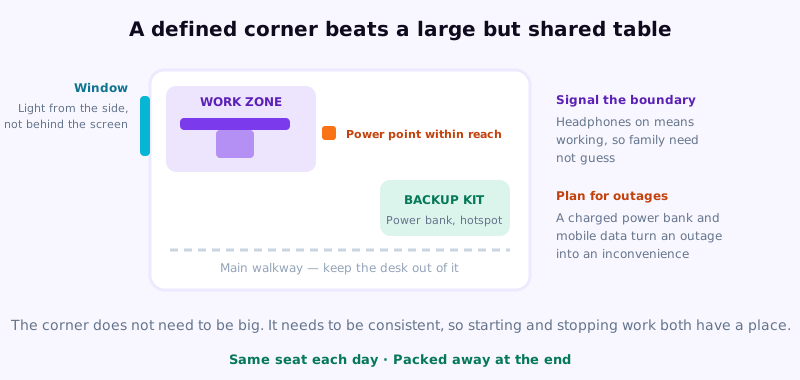
You do not need a dedicated room to have a productive workspace. What you need is a consistent, defined spot that your brain associates with work — even if that spot is a corner of the living room or one end of the dining table.
- Claim a corner, not a room: In a 1BHK, identify the spot with the best natural light and least foot traffic. A small desk (even a folding table) facing a wall in the bedroom can serve as an effective home office. The physical separation — even just turning to face a specific direction — helps your brain switch into work mode.
- Consider noise-isolating earphones: They can reduce distractions and signal to family members that you are occupied. Prices and performance vary, so choose a pair that is comfortable for your call length and suitable for your room.
- Get your chair height right: Aim for a relaxed shoulder position, level wrists, and a screen that does not make you lean forward. A laptop stand paired with a separate keyboard can help, but adjust the setup gradually and stop if it causes pain. Persistent discomfort deserves individual advice from a qualified professional.
- Manage the heat: Indian summers make home offices uncomfortable by afternoon. If possible, schedule your most demanding, focused work for the morning hours before the heat peaks. Position your desk near a fan rather than directly under it (direct airflow causes dry eyes over long sessions). A small table fan aimed at your feet rather than your face can significantly improve comfort.
- Keep the workspace tidy: A cluttered desk is a cluttered mind. Spend two minutes at the end of each work day clearing your workspace. This also serves as a physical ritual that signals the end of the workday — important when home and office share the same space.
Setting Boundaries With Family
This is arguably the most India-specific WFH challenge. In a culture where home is family space and work is something that happens outside the home, communicating that you are "at work" while physically sitting in the living room requires deliberate effort and sometimes repetition.
Communicate your schedule clearly and regularly
Share your rough work schedule with everyone in the house — not just once, but as a regular practice. "I have calls from 10–12 and 3–5 today" gives family members useful, actionable information. A shared family calendar or even a whiteboard on the kitchen wall with your day's schedule can work well in joint family setups.
Use signal systems
Establish simple physical signals that everyone understands. Earphones on means you are in a meeting or on a call — do not interrupt except for emergencies. A door closed (if you have one) means focused work time. These signals take a week or two to train, but they work. Be consistent with them.
Address the "you're at home anyway" problem
Parents and in-laws from an older generation often genuinely do not understand that remote work is real work. Rather than getting frustrated, try explaining it in analogies they understand: "My boss can see if I am online or not, just like clocking in at an office." Involving them in understanding your actual deliverables — "I have to submit this report by 5pm or my manager will ask why" — often helps more than abstract explanations about focus or productivity.
Schedule household task time deliberately
One reason family members pull you towards household chores is that they see you sitting at home and assume you are available. Pre-empt this by explicitly scheduling your household contribution: "I will help with grocery shopping between 12:30 and 1:30, and I can look at that after 6pm." This reassures family that you have not completely abandoned household responsibility — while protecting your work hours.
Managing Internet and Power Issues
Infrastructure challenges are a real part of the Indian WFH experience that needs practical solutions, not workarounds improvised in the moment.
- Have a mobile hotspot plan ready: Your home broadband will fail at some point — ideally not during an important presentation. Have a separate mobile data plan on a different operator (if Jio is your primary broadband, keep an Airtel or Vi SIM ready as a hotspot backup). Most 5G phones can share a connection fast enough for video calls.
- Consider a UPS: Runtime depends on the UPS capacity, connected equipment, battery condition, and power draw. Check the manufacturer's specifications and confirm that the model is suitable for your router or computer before buying; prices also vary by seller and date.
- Offline-first approach for critical work: Draft important documents locally in Word or Google Docs offline mode, rather than in browser-based tools that require continuous connectivity. Save your most connectivity-dependent tasks (video calls, large file uploads) for time slots when your internet is most reliable — usually early morning or late evening in most Indian cities.
- Communicate proactively on calls: If you live in an area with frequent power cuts, it is worth telling your team or clients this upfront — it removes awkwardness and allows you to set expectations. Most Indian colleagues will understand immediately; most international clients appreciate the transparency.
Building a WFH Routine That Sticks
The biggest productivity advantage of an office is not the desk or the air conditioning — it is the structure. Work starts at a fixed time, ends at a fixed time, and the commute creates a clear mental transition between work and personal life. Without these built-in rhythms, WFH can slide into a blurred, exhausting state where you are always half-working and never fully relaxed.
- Get dressed even at home: This sounds trivial but it works — the research on it is consistent. Staying in pyjamas all day keeps your brain in rest mode. You do not need to dress for an office; just change out of sleepwear into something you would wear to a casual outing. The physical act of getting dressed signals transition to your nervous system.
- Fix start and end times and defend them: Decide when your workday starts (say, 9:30am) and when it ends (6:30pm) and treat both as firm commitments. Without a fixed end time, Indian WFH workers especially tend to keep working into the night because there is no commute forcing them to stop. This leads to burnout faster than most people expect.
- Build a morning routine before opening the laptop: Even 20–30 minutes of a morning ritual before you sit down to work makes a significant difference. This could be tea and the news, a short walk, yoga, or simply a proper breakfast eaten sitting down. Starting the laptop the moment you wake up means you never fully transition into work mode — you just drift into it.
- Use meals and tea breaks as natural structure: In India, the rhythm of chai time (typically mid-morning and mid-afternoon) and lunch provides a natural structure to the day that offices also follow. Honour these rhythms at home. A 15-minute chai break is not wasted time — it is a mental reset that keeps you sharp for the next block of work.
Beating Afternoon Slumps and Distractions
The post-lunch energy dip is universal — but it hits harder at home where there is no social pressure to look alert and busy. Here is how to work with it rather than against it.
- The 20-minute power nap: Unlike in an office, you can actually do this at home — use it. A 20-minute nap (set an alarm; longer and you wake up groggy) after lunch can restore afternoon alertness more effectively than coffee. Keep it under 30 minutes to avoid entering deep sleep stages.
- Schedule lighter tasks after lunch: Reserve your hardest, most cognitively demanding work for morning hours when your focus is peak. After lunch, handle emails, administrative tasks, review documents, or attend routine meetings. Do not try to do your best creative thinking between 2 and 3pm.
- Try the Pomodoro Technique: Work in 25-minute focused blocks, then take a 5-minute break. After four blocks, take a longer break. This technique works especially well in Indian home environments because the break intervals give family members predictable windows to interact with you, which reduces the tendency to interrupt during focus blocks.
- Block distracting sites during work hours: Install a browser extension like Freedom, Cold Turkey, or even just use your router's parental controls to block time-sink sites during work hours. YouTube, Instagram Reels, and WhatsApp web are the biggest productivity drains for Indian WFH workers.
- Handle noise during calls: When you have an important call scheduled, give your household advance notice and pick the quietest room available. If vendor calls or domestic noise are a recurring issue, consider scheduling important calls for early morning before the household fully wakes up.
End-of-Day Rituals to Switch Off
When home is office, the boundary between work and rest becomes dangerously thin. Without a commute to decompress, many Indian WFH professionals find themselves checking work messages at 10pm and mentally "at work" even during dinner. This is unsustainable and damages both work quality and home life.
- Create a physical signal that work has ended: Just as getting dressed signals the start of work, create an end-of-day signal. An evening walk around the block, changing into home clothes, or sitting outside for 15 minutes with a cup of tea are all effective. The key is that this physical action becomes a consistent ritual your brain associates with "work is done."
- Shut down your laptop completely: Do not just close the lid. Physically shut down your laptop and ideally move it out of sight. A closed laptop on the dining table still pulls your attention. If it is in a drawer, it genuinely does not exist until morning.
- Set a rule: no work messages after a set time: Decide on a time — say 8pm — after which you do not respond to work messages. Communicate this to your team. Most genuinely urgent things can wait until morning; what feels urgent in the evening rarely is. Mute work WhatsApp groups from 8pm onwards and check them in the morning.
- Write tomorrow's priority list before closing: Spend five minutes at the end of your workday writing down the three most important tasks for tomorrow. This mental "download" closes open loops in your brain and makes it significantly easier to actually stop thinking about work in the evening.
Frequently Asked Questions
How to tell family you are busy without being rude?
Be specific rather than vague. "I am busy" is easy to dismiss; "I have a client call until 11:30 — I cannot be interrupted until then" is harder to argue with. Use physical signals consistently (earphones, closed door) and acknowledge their need: "I will help after 12, I promise." Consistency matters most — if you sometimes drop everything when interrupted and sometimes do not, family members cannot learn the pattern. Be patient; it typically takes 2–3 weeks of consistent signals for the new expectations to stick.
Best chair for WFH in India under ₹5,000?
At this budget, look at chairs from Green Soul, Cellbell, or Savya Home available on Amazon and Flipkart. Prioritise adjustable height, lumbar support, and a firm but cushioned seat. Avoid chairs that look impressive but have no lumbar curve — they cause back pain within weeks. A chair with armrests that sit at elbow height when you are typing is important. Read reviews specifically mentioning long-hour comfort rather than just appearance.
Which internet plan is best for WFH in India?
For primary broadband, Jio Fiber and Airtel Xstream Fiber offer the most reliable fibre connections in most Tier-1 and Tier-2 cities. Airtel generally has a slight edge on consistency and customer support. Choose a plan with at least 100 Mbps and unlimited data — the cheapest plans with data caps will cause anxiety and throttling at the worst times. Keep a 5G mobile SIM from a different operator as a backup hotspot; Jio 5G or Airtel 5G both work well for this purpose.
How to handle power cuts during video calls?
The three-layer solution: a UPS for your router (buys 20–30 minutes), a fully charged laptop (never work on AC power without the battery topped up), and mobile hotspot as a network backup. If a cut happens mid-call, calmly switch to hotspot and rejoin — most team members in India will understand immediately. For critical presentations, consider scheduling them for early morning when power is typically more reliable in most Indian cities.
Is WFH actually more productive than the office?
It depends heavily on the individual and their home environment. Research from Stanford and other institutions shows that workers in quiet, dedicated spaces are more productive from home — they save commute time, have fewer interruptions from colleagues, and have more autonomy over their environment. However, workers in noisy, shared spaces without clear boundaries often do better in an office. For most Indian professionals, the answer is "hybrid" — deep focus work at home, collaboration and meetings in the office — which is increasingly the direction most Indian companies are moving.
Working from home in India is a skill — one that takes deliberate practice to get right. The professionals who thrive in WFH setups are not the ones who have a perfect home office or a silent house. They are the ones who acknowledge their specific constraints, build systems around them, and maintain the discipline to protect their work time and their personal time with equal firmness. Start with one or two changes from this list and build from there.